
Blog · 24 June 2026
How to move an upright piano safely
Moving an upright piano safely means getting the weight, the access and the protection right before the instrument moves a centimetre. An upright weighs between 150 and 250 kilograms depending on the model, it is top-heavy and it has no natural handholds. The difference between a move that goes well and one that does not is almost always planning and equipment rather than strength. If you are weighing up whether to use specialist piano movers or manage it yourself, the weight alone is usually enough to settle that question.
How an upright piano is built, and why that makes it hard to move
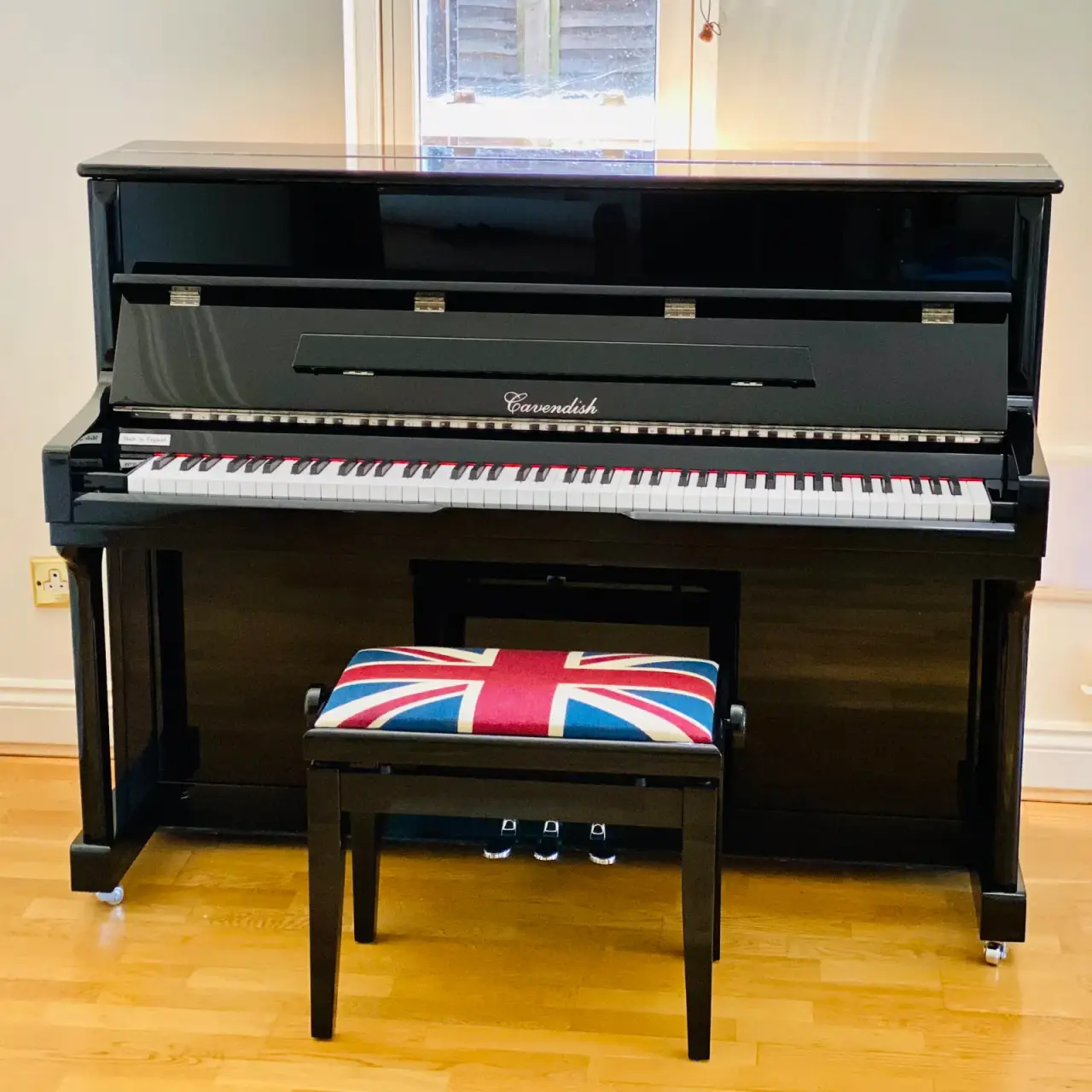
Uprights carry most of their weight at the top and towards the back. The cast-iron plate, the strings and the soundboard all sit there, with the action and keys further forward and lower down. That top-heaviness makes the instrument want to tip the moment you try to tilt it, and if it goes past a certain angle you lose control quickly. It also means that a single hard knock on one corner is dropping several hundred kilograms onto a wooden joint that was not designed for impact. The case, particularly on a polished black or satin-finished instrument, marks from straps and from bare contact with doorframes in ways that are expensive to put right.
The equipment you actually need
A successful upright piano move needs specific kit, not improvised alternatives. A standard furniture blanket does not stay put on a polished case under load. Standard removals straps are rarely long enough to run safely under the instrument. A flat four-wheeled furniture dolly is too low and too unstable for a 250kg instrument on anything except a perfectly flat, smooth floor.
- A fitted transit cover made specifically for pianos, not a loose blanket
- A padded piano skid board for the flat sections of the move
- A proper piano dolly with adjustable securing straps
- A stair-climbing trolley or ramps for any route that involves steps
- Three crew members for stairs, four for a tight turn on a staircase
At PianoSpeed we use top-of-range triple-thickness fitted transit covers on every upright move. The piano travels on a padded skid board rather than on its own castors for distances beyond a few metres, because the castors are designed for nudging the instrument across a room, not carrying full weight over a threshold or down a step. The crew is piano-trained, not general removals staff who move a piano occasionally.
Measuring the access before the day
The road is rarely the problem. Getting the piano from where it stands to the vehicle, and from the vehicle to where it needs to go, is where nearly everything goes wrong. Uprights are typically 148 to 153 centimetres tall, 135 to 155 centimetres wide and 55 to 65 centimetres deep, though this varies considerably by model and age. Before any move, measure every doorway on the route at both addresses, every hallway width and tight turn, the staircase width and head height if stairs are involved, and the internal dimensions of any lift.
Many uprights pass through a standard UK doorway without any adjustment. Others need to be tilted slightly on the skid board, laid on their backs, or partially disassembled: the top lid removed, the lower panel taken off, the pedal assembly detached. Knowing this in advance, from actual measurements, is what separates a smooth move from a costly improvisation on the day.
Stairs
Stairs are the highest-risk part of a piano move and they are priced accordingly. Whether the piano needs to travel nose-first or back-first depends entirely on the staircase geometry: pitch, landing width, any turns in the flight and the ceiling clearance at the turn. Some staircases work with a stair-climbing trolley. Some require the piano held at a steep angle by a coordinated crew of four. Some narrow Victorian staircases require rigging equipment that mounts temporarily to the stairwell. None of this can be safely improvised by a crew that does not move pianos as their main work.
Stair access is chargeable. The instant online quote asks for the number of floors at both collection and delivery addresses and whether a lift is available, then calculates the access charge automatically. The price you see accounts for the real job at both ends.
What to tell your piano movers
The clearer the information you give when booking, the smoother the day will be. These are the things that matter most:
- The make and model if you know it, or a description of the size (small upright, studio upright, full-size upright)
- The number of steps at the collection address and the delivery address
- Any narrow hallways, low ceilings or tight turns on the access route at either address
- Whether a lift is available and, if so, its internal width and depth
- The delivery postcode, which determines the weekly scheduled delivery day
Questions people commonly ask
Can I move an upright piano myself?
A light digital piano can be moved by two careful people with a sack trolley. A real acoustic upright, particularly one above 180 kilograms, needs proper equipment and a crew of at least three people who understand how piano weight shifts when the instrument tilts. Most DIY attempts on stairs end with a damaged instrument, a damaged wall, or a person hurt by a sudden shift in the load.
How many people do you need to move an upright piano?
Two people with the right kit is the minimum on a flat, obstacle-free route. Stairs normally need three. A full-size upright on a staircase with any turn needs four people working in coordination.
Does an upright piano need tuning after it has been moved?
Usually, yes. The move itself rarely disturbs the tuning directly, but the change in temperature and humidity at the new location almost always does, often within a few days. Expect to have the piano tuned two to four weeks after it arrives and again roughly six months later once it has fully settled.
What is the difference between a specialist piano mover and a general removals firm?
A general removals firm will sometimes accept a piano job, but is unlikely to carry fitted transit covers, purpose-built skid boards, or a crew that understands how piano weight distributes when the instrument is tilted. The risk of case damage and of crew injury is higher. PianoSpeed moves pianos every working day. We are rated 4.9 out of 5 on Trustpilot from 77 reviews, all from real piano moves. Every move is fully insured.
Do piano castors matter for a move?
Castors are designed to let you shift the piano a few feet across a room, not to carry full weight over a threshold, down a step or across an uneven surface. A specialist crew takes the piano off its castors onto a skid board the moment it leaves its room. Leaving the piano on its castors for a move is one of the most common causes of a cracked leg or a damaged floor at the delivery end.
Book a specialist upright piano move
Piano moves start from £125. For an exact fixed price covering your specific instrument, access and destination, get an instant quote at book.pianospeed.com. Answer a few questions about the piano and both addresses and you will see a fixed price and available dates. Book in two minutes, or call 020 7164 0000 to talk through any access questions first.
Book your move in 2 minutes
When it has to arrive perfectly, there is no second choice.
Get an instant quote★★★★★ Rated 4.9 out of 5 on Trustpilot from 77 reviews