
Blog · 16 July 2026
Moving a Steinway safely: what a specialist does differently
Moving a Steinway is different from moving other pianos in one specific way that matters: the combination of significant value and mechanical precision means the margin for error is much smaller. A specialist crew approaches a Steinway differently at every stage, from the preparation at the collection point to the final placement and reassembly at the destination. This article sets out what that looks like in practice.
For an immediate quote on moving a Steinway, go to book.pianospeed.com. If you need to talk through the method for your specific model, call 020 7164 0000.
What makes a Steinway different to move
Steinway grands range from the compact Model S to the full concert Model D, and the value of each is considerably higher than a comparable instrument from most other makers. That changes the financial stakes: damage that would be straightforward to repair on a lower-value instrument can be expensive on a Steinway, where parts are brand-specific and specialist work is sometimes needed after any repair to the action.
The precision of the Steinway action is a second consideration. The hammers in a Steinway grand are individually voiced, and the regulation, the process that ensures each key responds exactly as intended, is carried out by a Steinway technician to tight tolerances. Any rough handling that shifts the action components risks changing the feel of the keyboard in ways that need specialist work to put right.
Preparing a Steinway grand for the move
Before a Steinway grand moves, the crew works through a specific sequence at the collection point. The lid is closed and the fallboard is secured. The music desk is removed and padded separately. The three legs are unbolted in the correct order: the single leg at the keyboard end is removed last, because removing it too early causes the body to tip without support. The pedal lyre, the unit housing the three pedals and their rods, is unbolted carefully, since the rods connect to the action mechanism and the attachment points need to be handled without stress.
Once the legs and lyre are off, the body is tipped carefully onto a purpose-built padded skid board. The piano travels on its straight side, bass end down on the board, with the keyboard end facing up. The case is then wrapped in a fitted, triple-thickness transit cover. For a polished ebony Steinway or a walnut finish, the wrap needs to be smooth and even across the surface, since a cover that bunches against a polished case can mark the finish in transit. The legs and lyre each go into padded bags and are stowed in a heavy duty crate for the journey.
Steinway uprights: a different set of considerations
Steinway uprights are heavy instruments and require the same care as any Steinway grand. The keyboard lid is secured before the move, the instrument is padded and moved on an upright dolly, and the access at each end is assessed in advance. Because Steinway uprights can be significantly heavier than a comparably sized instrument from other makers, the crew confirms the stair situation and the method before the day.
Stairs are chargeable for a Steinway upright as they are for any piano. If the access involves stairs, the booking team needs to know the width of the staircase, whether there is a half-landing, and the height of each flight. That information is entered on the online booking form at book.pianospeed.com and the stair charge is calculated automatically.
Stairs and access challenges
For a Steinway grand going up or down stairs, the length of the body on the skid board and the weight of the instrument determine the method. Many grands can be handled on wide London staircases with a trained crew and the right equipment. On narrow Victorian stairs, in tight Edwardian hallways, or at access points where a grand cannot turn safely, the method changes.
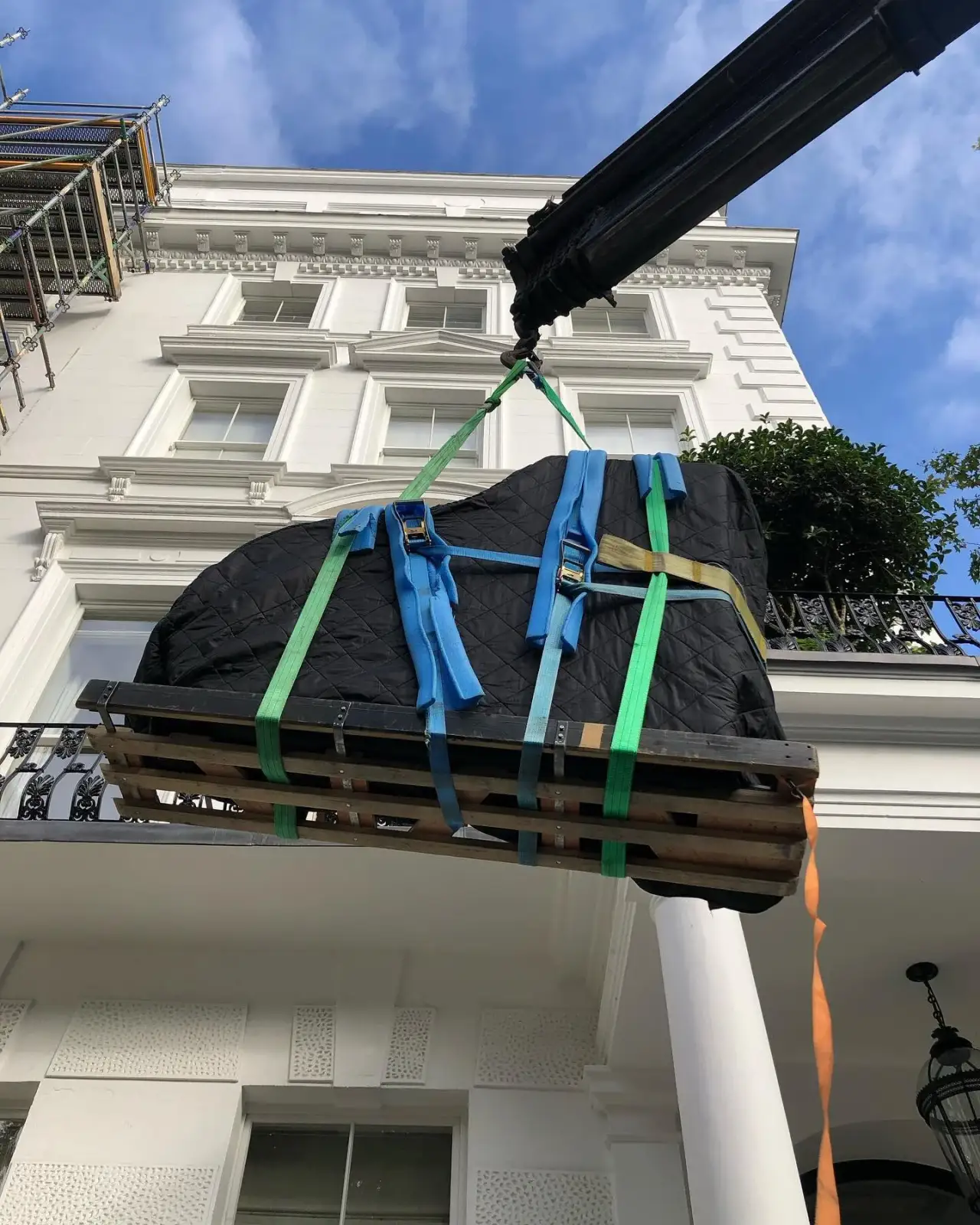
Where a staircase crew cannot manage the access, the solution is a crane lift. The piano is lifted externally through a window opening or over a balcony. The access is assessed and the method is confirmed before the day, so the price reflects the real job. Describe the access accurately when you book so there are no adjustments on the day.
At the destination
When the Steinway arrives, the crew checks the route through the destination before the piano comes off the vehicle. For a grand, the orientation of the case on the skid board determines how it enters the room and which way it tips up when the legs are reattached. This is worth thinking through in advance, especially in a room with limited turning space or a low ceiling above the intended position.
The legs are reattached in the reverse order to removal and the lyre goes back on once the body is stable. Before the transit covers come off, the crew checks the case for any marks. If there is any surface blemish on delivery, it should be flagged and documented before the crew leaves.
After the move: settling and tuning
Every piano that moves needs time to settle before it is tuned. For a Steinway, most piano technicians recommend waiting two to four weeks. The instrument needs to equilibrate to the temperature and humidity of its new location before a tuning will hold reliably.
Steinways are particularly responsive to changes in humidity. The soundboard and the wooden components will adjust over the first few weeks in a new space, and tuning before that adjustment is complete often results in the pitch drifting again quickly. If the piano is moving from a different part of the country, from storage, or from a property with a different heating setup, the settling period matters more rather than less.
Tell the technician that the piano has recently moved when you book the service call. A technician who knows the instrument has just arrived can assess the regulation alongside the pitch and advise whether anything needs attention beyond a standard tune. If the piano has covered a long distance or been in storage, a full regulation check from a Steinway specialist may be appropriate after the instrument has settled.
For a fixed price on moving your Steinway, go to book.pianospeed.com and describe the access at both ends accurately. You can also call 020 7164 0000. PianoSpeed is rated 4.9 out of 5 on Trustpilot from 77 reviews, all from real piano moves across London, Surrey and the UK.
Book your move in 2 minutes
When it has to arrive perfectly, there is no second choice.
Get an instant quote★★★★★ Rated 4.9 out of 5 on Trustpilot from 77 reviews