
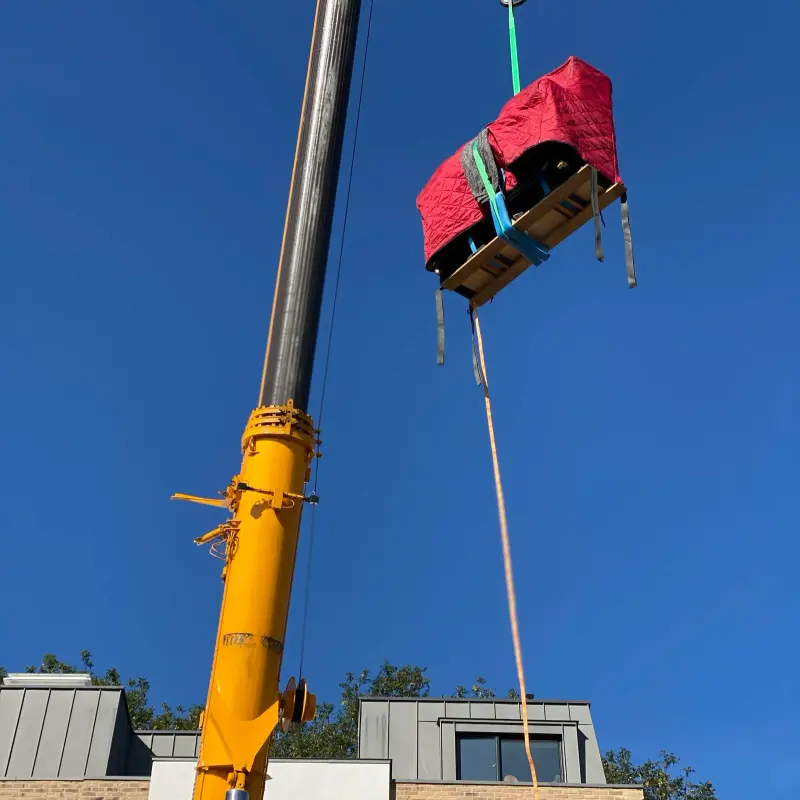
Blog · 19 August 2026
First floor piano delivery without a lift: what the crew actually does
For a first floor piano delivery without a lift, a specialist crew carries the instrument up the staircase on a padded skid board, using a method planned around the exact geometry of the stairs before anyone touches the piano. In most London houses and purpose-built flats, a standard upright goes up a single straight flight with three people and the right equipment. The method and cost depend on the specific staircase at your address, so access including stairs is priced automatically when you enter the floor level at book.pianospeed.com.
Why one flight of stairs is not a simple job
People often underestimate a first floor delivery because it is only one flight. The piano does not know that. A standard upright weighs between 150 and 250 kilograms and its weight sits high in the case. The moment the instrument is tilted to match the angle of the stair pitch, that weight shifts forward and downward in a way that requires controlled, coordinated effort to hold.
Most of the damage that happens during a piano move occurs not in the van but at staircases, narrow doorways and tight turns. On a single flight, every one of those risk points is compressed into a short distance. The bottom door, the first step, the landing and the flat or room door all follow in quick succession, with the crew managing a heavy, awkward load at an angle throughout. A specialist crew works through these transition points methodically. An improvised one usually gets into difficulty at one of them.
For a London upright delivery, get a fixed price at book.pianospeed.com by entering the floor level and access details at both addresses.
What the crew does before the piano leaves the ground
The first thing a specialist crew does at a first floor delivery without a lift is read the staircase. This is not a formality. The measurements and geometry at the specific address determine the approach angle, the number of people needed and whether any additional equipment is required.
The crew will check the staircase width at its narrowest point, which is often where a banister newel post or a low ceiling restricts the available space. They will look at the pitch of the flight, the height of the ceiling at the top step, and whether the landing requires the piano to turn. All of this is ideally assessed from the access details provided at booking, so the crew arrives prepared for the specific job and is not problem-solving on the day.
Before the piano moves, fitted transit covers are applied to the whole instrument. On a staircase, where the case will be held at an angle and moved past fixed objects including banister rails and walls, a well-fitted cover is part of the protection plan rather than an optional extra. At PianoSpeed, triple-thickness fitted covers are used on every move.
How the piano actually travels up the stairs
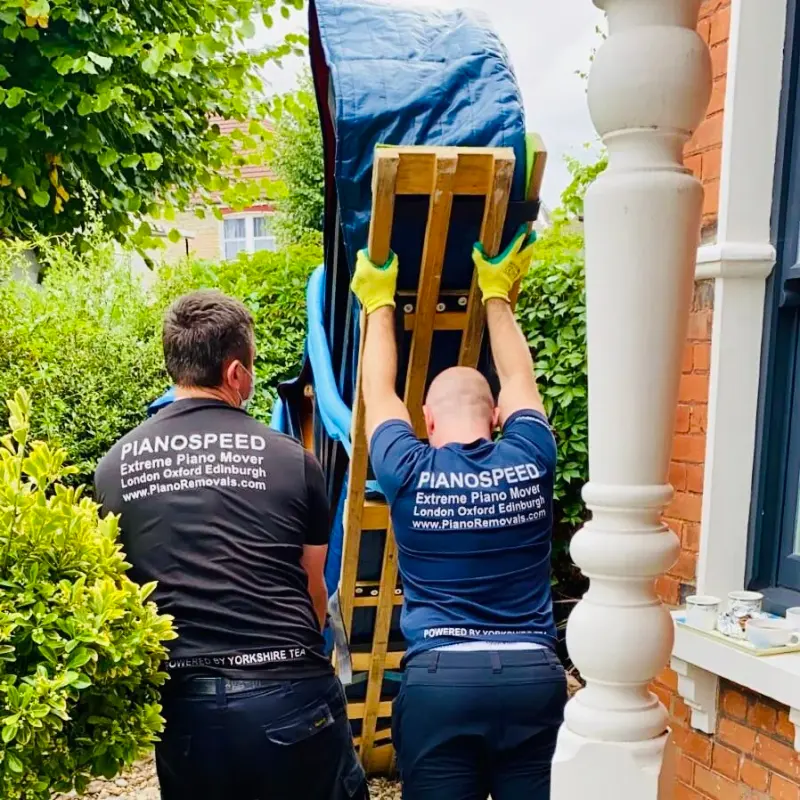
The piano is placed on a padded skid board at ground level. The instrument rides on this board for the entire stair section and does not travel on its own castors, which are not designed for the loads involved in stair carrying. The crew then angles the board and instrument to match the pitch of the flight, with each person holding a defined position.
On a straight flight, the typical approach is one person at each end of the skid board and one person in the middle, working in a coordinated lift-and-step pattern. Communication between the crew is constant throughout the flight. The crew member at the bottom of the flight has a restricted view upward and relies on the crew member at the top calling the steps and any obstructions.
At the top of the stairs, the piano is lowered back to horizontal before the crew rotates it through the landing and into the flat or room. This transition from angled to flat is one of the load-sharing moments that makes specialist training important. The weight redistribution at that point is significant and must be absorbed smoothly rather than allowed to shift suddenly.
How many people a first floor job needs
Crew size scales with the difficulty of the access, not with the size of the job.
- Standard upright on a straight single flight: three people in most cases
- Upright over 200 kilograms or a wider model: four people
- Any flight with a dog-leg turn or a restricted half-landing: four people, with the fourth positioned at the landing to take weight through the turn
- Baby grand or grand piano to the first floor: four people minimum, with the legs, lid and pedal assembly removed and packed before the body goes near the stairs
- Concert grand to the first floor without a lift: an individual access assessment and usually stairwell rigging rather than a manual carry
PianoSpeed crews are sized to what the access actually requires. A crew of two might technically complete a straightforward first floor job on a wide, straight staircase, but three is the standard because the safety margin matters more than the saving on crew time.
Victorian and Edwardian properties
Most of the first floor deliveries without a lift that PianoSpeed handles in London take place in Victorian and Edwardian houses and flats. These properties were built at a time when pianos were standard household furniture, but the staircases were designed for people, not for piano moving.
The typical dimensions are a flight width of around 700 to 850 millimetres, a steep pitch, and a landing that turns 90 or 180 degrees at the top. Ceiling height at the landing turn can be lower than expected, particularly in converted houses where the upper floors have been divided into flats. These are exactly the dimensions that require the staircase to be assessed before the day, not assumed.
An upright piano is typically 135 to 155 centimetres wide. Most Victorian flights will accommodate this, but the approach angle and the turn at the landing are what determine whether the job is straightforward or needs additional crew and equipment. A specialist crew plans the specific approach for the specific staircase. A general removals team tends to decide on the day, which is where problems start.
First floor grand piano delivery without a lift
A grand piano to the first floor without a lift is a different scope from an upright. Before the instrument goes near the stairs, the legs are removed and packed individually in padded bags, the pedal lyre comes off separately and is wrapped, and the lid is secured. The body of the grand then travels on a padded skid board on its flat side.
A baby grand body with the legs removed is roughly 120 to 150 centimetres at its widest point. Many London first floor staircases can accommodate this, but the ceiling height at the landing and the geometry of any turn are the variables that determine the method. For a larger grand or a very tight staircase, stairwell rigging is sometimes the right answer rather than a manual carry. This is assessed individually, and the method is confirmed before the day.
What to do before the crew arrives
- Clear the full route from the front door to the piano's destination room, including any corridor turns and the landing
- Remove loose rugs, stair runners and doormats from the flight, as these create a slip risk under load
- Take down any pictures or mirrors on walls that the piano will pass on its way up
- Check whether your building requires advance notice for a large delivery
- Make sure parking is arranged in advance, particularly if the property is in a controlled parking zone
If you know the staircase width at its narrowest point, the ceiling height at the landing and the make and model of the piano, share those details when you book. The more accurate the access description, the more precisely the crew can plan the job before arriving.
Common questions about first floor deliveries without a lift
How much does a first floor piano delivery without a lift cost?
Stair access is chargeable and the cost depends on the floor level, the difficulty of the staircase and the access at both addresses. Piano moves start from £125. The instant quote at book.pianospeed.com asks for the floor level and access details at collection and delivery and calculates the stair charge automatically. The price you see is fixed.
Will my banisters or walls be scratched?
A specialist crew uses fitted transit covers on the piano, temporary stair pads and banister protection where the access warrants it. On a standard domestic staircase with adequate width, a well-planned stair move produces no contact with walls or banisters. On a very tight flight, some contact is difficult to avoid entirely, which is why protection is applied before anything moves. The crew will say so before starting if it applies to your staircase.
Can my upright piano fit on a typical London first floor?
Most standard uprights fit most London domestic staircases, but the specific approach angle, the landing geometry and the ceiling height at the top of the stairs all need to be factored in. A compact studio upright at around 110 centimetres tall is considerably easier to handle at a turn than a full-size model at 131 centimetres. Share the make and model when you book so the crew knows the dimensions.
Can I use the staircase lift instead of having the crew carry it?
Most residential stairlift chairs are designed for people and do not carry piano-sized or piano-weight loads. The lift rails and mechanism are not rated for it. If you have a service lift or goods lift with appropriate load capacity, share the internal dimensions when you book and the crew will assess whether it is usable.
How long does a first floor stair carry take?
The stair section of a first floor delivery without a lift typically takes 15 to 30 minutes, depending on the staircase geometry and the instrument. The total job time depends on the piano type, the floor at collection, and the distance between addresses. When you book, the crew confirms the expected duration based on the specific access details.
Book a first floor piano delivery
Piano moves start from £125 and stair access is priced automatically in the online quote. For a fixed price covering your instrument, the access at both addresses and a confirmed date, get an instant quote at book.pianospeed.com. Or call 020 7164 0000 if you want to talk through an unusual staircase or access situation before booking. PianoSpeed London Limited is rated 4.9 out of 5 on Trustpilot from 77 reviews.
Book your move in 2 minutes
When it has to arrive perfectly, there is no second choice.
Get an instant quote★★★★★ Rated 4.9 out of 5 on Trustpilot from 77 reviews