
Blog · 23 August 2026
How a piano is wrapped and secured for transport: step by step
A specialist piano crew wraps an upright in triple-thickness fitted transit covers and positions it on a padded skid board. A grand has its legs, pedal lyre and lid removed before the case travels on its side in a heavy-duty padded crate. The wrapping is not a precaution added on top of the move: it is the move. Without it, the casework, the finish and the instrument's internal action are all at risk from even a short journey. Below is the exact sequence a PianoSpeed crew follows from the moment they arrive at the door to the moment the covers come off in the destination room. You can get a fixed price for your move at book.pianospeed.com.
Why piano wrapping differs from furniture wrapping
A domestic removal crew protects furniture with furniture blankets: folded pads draped over a surface and held loosely with straps. That method works for a wardrobe or a chest of drawers. It does not work for a piano, because the instrument has projecting parts (the keyboard lid, the top lid, the pedal lyre on a grand), internal components that can shift if the instrument is tilted at the wrong angle, and a lacquered case that shows contact marks from anything that presses against it in transit.
Fitted transit covers are made specifically for pianos. They hold their shape around the instrument's own contours, so there is no loose fabric that can bunch against the casework or work its way under a hinge. They wrap the keyboard end, the top and the sides as separate panels, with padded sections where contact is most likely. A furniture blanket does not do any of that.
Wrapping and moving an upright piano: step by step
The sequence below describes what happens on the collection day for a standard upright. The delivery process is the reverse: covers stay on until the piano is in its final position inside the room.
Step 1: clear the route and assess the access
Before the crew touches the instrument, they walk the route from the piano to the vehicle. They note doorway widths at their narrowest point, the floor surface on any ramp or step, whether any doors need to come off their hinges, and whether the piano will need to be tilted to pass through a tight corridor. All of this is noted before wrapping starts, because the wrapping approach changes depending on how the piano will be moved.
Step 2: close and secure the keyboard lid
If the keyboard lid has a lock, the crew asks you for the key and locks it. If it does not lock, they secure it with protective tape that leaves no residue. The keys themselves are the most delicate part of an upright: even a small knock to the exposed keyboard can chip the keytops. Keeping the lid down and secured is the first protection layer.
Step 3: remove loose items from inside the case
Sheet music sitting on the music desk, items stored in the lower toe panel, and anything placed behind the top lid must come out before the instrument is wrapped. Loose items shift when the piano is tilted or rolled, and a heavy object inside the case can make contact with the action and damage it. The crew will check inside the top lid; the owner should check the toe panel before the crew arrives.
Step 4: fit the transit covers
Triple-thickness fitted transit covers are placed over the instrument panel by panel. The sections cover the top, the keyboard end, the back and the sides separately, with each panel secured to the next so the full cover holds its position rather than slipping as the piano moves. On an older piano with delicate or already-crazed lacquer, the crew notes this and adds additional padding at the contact points before the outer cover goes on.
Step 5: position on the padded skid board
Once the piano is wrapped, it is tilted carefully and a padded skid board is slid underneath. The skid board is a low, wheeled board with a padded surface that spreads the instrument's weight and allows it to be rolled on smooth surfaces without touching the castors. The piano's own castors are not used for moving: they are not designed to take the full weight of the instrument under load. On some floors, the crew places a runner mat in front of the skid board to protect the floor surface as the piano is rolled toward the exit.
Step 6: move through the building and load into the vehicle
The wrapped piano on its skid board is rolled or carried to the vehicle. Stairs are handled by the crew using a stair-climbing technique specific to the type of staircase; a straight flight is different from a turn. At the vehicle, a tail lift or loading ramp brings the piano to vehicle height. Once inside, the piano is strapped to the vehicle's internal securing points so it cannot shift in transit. The straps go over the fitted covers, not against the bare case.
Wrapping and moving a grand piano: step by step
A grand move takes more time than an upright move and involves more individual wrapping stages. The extra time is reflected in the quote at book.pianospeed.com.
Legs and pedal lyre: removed and individually packed
A grand piano has three legs. Each is unbolted and wrapped individually in a padded leg bag before being placed in the vehicle. The pedal lyre, which carries the sustain, sostenuto and soft pedals, is also removed and packed in its own padded bag. These components are stored in the vehicle separately from the case, so there is no risk of the leg bolts or metal fittings contacting the main case during transit.
The lid: removed and wrapped flat
The grand piano lid is removed from its hinges and wrapped in its own protective cover. It travels flat in the vehicle rather than in an upright position, because a lid that is standing on its edge is vulnerable to vibration and any lateral movement in transit. The lid hinge hardware stays with the lid so nothing is mislaid.
The case: on its side in a heavy-duty padded crate
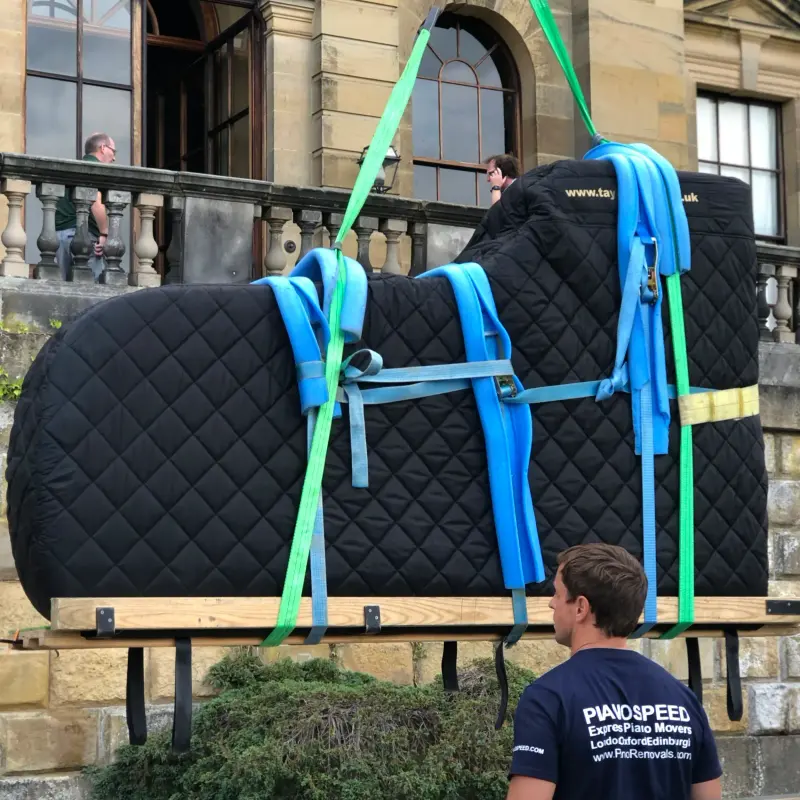
With the legs and lid removed, the grand case is lowered onto its side onto a heavy-duty padded crate. The crate supports the entire underside of the case and holds it at the right angle to keep the instrument stable during the journey. The case on its side is lower and more manageable than the full instrument standing on its legs, and the padded surface of the crate protects the lacquer at every contact point. The case is then wrapped in its own fitted transit cover and strapped to the crate before loading.
Loading and securing in the vehicle
The crated case, the legs in their individual bags and the lid in its cover all load into the vehicle in a fixed sequence so each item is accessible at the delivery address in the right order. The crate is strapped to the vehicle's securing points. Nothing in the vehicle should move independently during transit. A correctly loaded piano vehicle makes almost no noise from the cargo area on the road; if there is movement and contact noise, something is not secured correctly.
What to expect at the delivery address
The covers come off only once the piano is in its final position in the room. For an upright, the skid board goes under the instrument at the vehicle and comes out once the piano is at its standing position on the castors. For a grand, the legs are reattached in position before the crate and covers are removed, so the instrument is never resting on the floor without its legs in place.
The crew will not remove covers in a corridor or a hallway: the instrument travels wrapped through every shared space and is uncovered only in the destination room. This protects the casework and avoids any contact with door frames, radiators or other surfaces along the route.
Common questions about piano wrapping in transit
What is the difference between a fitted transit cover and a furniture blanket?
A furniture blanket is a flat, folded pad that drapes over a surface loosely. A fitted transit cover is cut to match the piano's shape and holds its position around the case. It does not slip or bunch, there are no loose edges that can catch on a door frame, and the padding is in the right places for a piano rather than distributed evenly across a flat surface. A specialist piano crew does not use furniture blankets for a piano.
Does wrapping a piano prevent it going out of tune?
No. Wrapping protects the casework, the action, the keys and the finish during transit. A piano will go out of tune whenever it is moved because the change in temperature and humidity between the old and new location causes the strings and the soundboard to shift. The instrument needs tuning after a move regardless of how well it was wrapped in transit.
Will the crew wrap my piano if the access is difficult?
Yes. The wrapping does not change based on access difficulty. What changes is the sequence: on a difficult access, the crew may wrap the piano before moving it even a short distance from its standing position, to ensure it is protected through any tight manoeuvre.
Are stairs included in the price?
Stair access at either address is chargeable and is priced automatically when you enter the floor level and lift availability at book.pianospeed.com. The figure you see is a fixed price, not an estimate that changes on the day.
Can I help the crew during the wrap and move?
The safest role for the owner during the move is to keep the route clear and be available to answer questions about access and the destination room. The crew handles the wrapping, the loading and the manoeuvring. A second pair of hands that is not part of the trained team can create a hazard rather than help, particularly on a staircase or at the vehicle.
How long does wrapping take?
For a standard upright, the wrapping and preparation at the collection address typically takes fifteen to twenty minutes. A grand takes longer because of the leg removal, lid removal and crating, which together usually add thirty to forty-five minutes to the collection time. Both figures can change with access difficulty. If the crew has to remove a door from its hinges or navigate a particularly tight staircase, allow more time.
Get a fixed price for your piano move
Piano moves start from £125. For a fixed price covering the wrap, the access at both addresses and a confirmed delivery date, get an instant online quote at book.pianospeed.com. Or call 020 7164 0000 if you have a question about access before booking. PianoSpeed is rated 4.9 out of 5 on Trustpilot from 77 reviews. PianoSpeed London Limited, 71-75 Shelton Street, Covent Garden, London WC2H 9JQ.
Book your move in 2 minutes
When it has to arrive perfectly, there is no second choice.
Get an instant quote★★★★★ Rated 4.9 out of 5 on Trustpilot from 77 reviews