
Blog · 10 August 2026
How to choose a piano moving company: five questions to ask first
The five questions worth asking any piano moving company are: do they specialise exclusively in pianos, what transit protection do they carry, how do they handle a grand piano's legs and pedals, what does their insurance actually cover for a musical instrument, and how is the price fixed before the crew arrives. A company that gives clear, specific, concrete answers to all five is the one to book. A vague answer to any one of them is useful information too. PianoSpeed covers London, Greater London, Surrey and GB mainland, with a Belfast to England lane. You can compare and get a fixed price in two minutes at book.pianospeed.com.
Question one: do they specialise in piano moving, or is it one job among many?
This is the foundational question, because everything else follows from it. A firm that takes piano jobs occasionally treats a piano as a large, awkward piece of furniture. A specialist treats it as a musical instrument that is simultaneously a structural assembly of wood, cast iron, felt and delicate regulation components, all of which respond badly to the wrong handling method.
The practical difference shows up in the equipment they carry, the training their crews have, and the insurance they hold. A firm that does four piano jobs a year will not have invested in fitted piano transit covers, purpose-built dollies or a crew that understands how a grand piano's centre of gravity shifts when it tilts. Ask directly: what proportion of your jobs are pianos? What specific piano-moving training do your crew have? A straightforward answer, or no answer, both tell you what you need to know.
Question two: what transit protection do they carry?
The equipment a specialist carries is the clearest signal of whether they have done this properly. The right answer involves three things: fitted transit covers sized for the specific instrument, a padded skid board for every section of the move beyond a short distance, and purpose-built piano dollies with the load capacity to hold the full weight of the piano safely.
- Fitted, triple-thickness transit covers that stay in place around corners and on stairs, not loose furniture blankets that shift under load
- A padded piano skid board used for every move beyond the shortest distances
- Purpose-built piano dollies with sufficient capacity for upright pianos and grands
- Individual padded bags for each grand leg and for the pedal lyre
- A heavy-duty crate for the grand body when access requires it
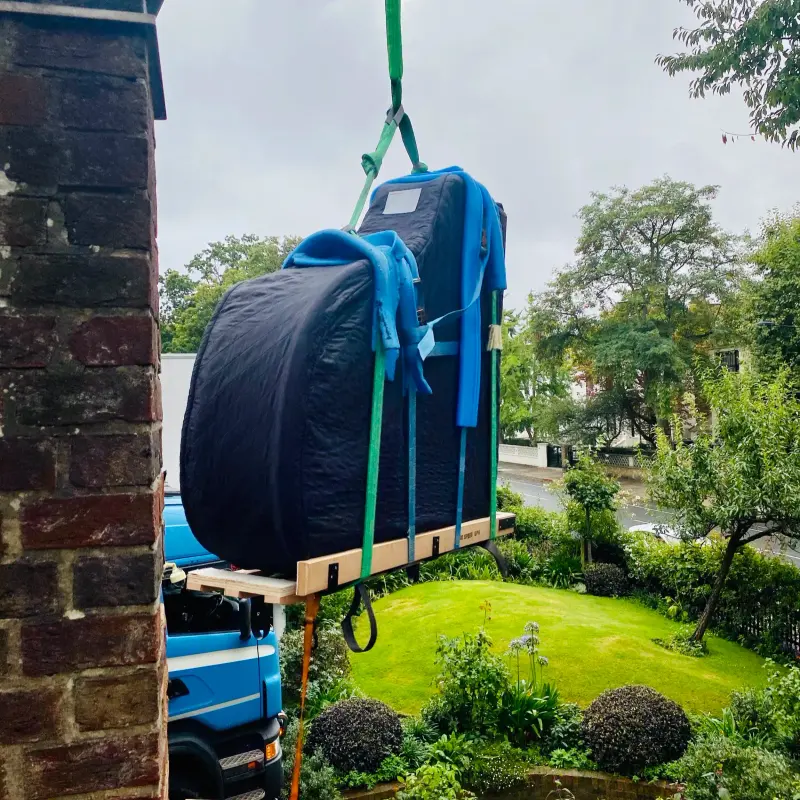
PianoSpeed uses top-of-range triple-thickness fitted transit covers tailored to each instrument. These cover the case, the keys and the polish from the moment the piano moves, and they stay in place through staircases and tight turns. A loose furniture blanket laid over a Steinway or a Bechstein does not do the same job. If a company cannot describe the covers they use in specific terms, they probably use blankets.
Question three: how do they handle a grand piano's legs and pedals?
This question is a technical litmus test. On a grand piano, the legs and the pedal lyre are the most vulnerable parts of the instrument and among the most costly to repair or replace if damaged. A specialist crew follows a deliberate sequence: the lid is closed, the music desk is lifted out and wrapped separately, then the two side legs are removed first. The single leg at the keyboard end is removed last, because the body needs both side legs for support before that leg can safely come away. Removing the keyboard-end leg before the side legs causes the body to tip forward without warning.
The pedal lyre is then unbolted with care. The rods that run from the pedals up into the action mechanism are fragile at their attachment points, and lateral stress during removal can bend or crack a rod. Each leg goes into an individual padded bag, and the lyre goes into its own bag. The body travels on its straight side on a padded skid board, not on its own castors. A company that cannot explain this sequence has not trained their crew for grand piano work.
For an upright, the question is simpler: does the keyboard side remain padded and protected throughout the move, and is the right dolly used for the piano's weight? A crew that uses a generic furniture trolley rather than a piano dolly with adequate capacity is taking a risk with the instrument.
Question four: what does their insurance actually cover?
Most removals firms carry goods-in-transit insurance. The critical detail is what those policies cover for a high-value musical instrument. Many standard goods-in-transit policies have per-item limits well below the replacement value of a good upright, and some exclude high-value items entirely unless they have been declared in advance.
The question to ask is specific: what does your policy cover for this piano, and what is the process if a claim is needed? A specialist piano mover carries insurance written around the specific risks of piano moving and should be able to confirm in writing what the policy covers for your instrument. A clear, concrete answer is what you are looking for. Vague reassurance is not.
Ask also how the company documents the condition of the piano before the move starts. A specialist who photographs the instrument and notes any pre-existing marks before anything is moved gives both parties a clear record if a question about damage arises later. A company that does not document the starting condition is exposing both themselves and you to an unresolvable dispute.
Question five: how is the price fixed, and what happens with stairs?
The price should be calculated from the specific details of your job: the type of piano, the collection address, the delivery address, and the access at both ends. It should be fixed before you confirm, not an estimate subject to adjustment when the crew arrives.
Stairs are a meaningful cost factor in piano moving and should be priced at the time of booking, not added as a surprise on the day. Access including stairs and floor level should be asked during the booking process and included in the fixed quote. A company that quotes a flat rate without asking about stairs is either planning to adjust the price on arrival or is not accounting for the real cost of the access.
At book.pianospeed.com, the booking form asks for the floor level and lift availability at both the collection and delivery addresses, and the stair charge is calculated automatically. The price you see before you confirm is the price you pay.
Frequently asked questions
What if a mover gives vague answers to these questions?
Treat vagueness as the answer itself. A specialist who moves pianos on every shift knows their equipment list, knows their insurance policy and knows exactly how they handle grand legs. Uncertainty or deflection on any of these points suggests the company has not built the expertise or the infrastructure around piano moving as a core specialism.
Is the lowest quote the right way to compare piano movers?
Price is one factor, but it only makes sense alongside the other four. A lower quote that does not include proper transit protection, a trained crew or adequate insurance may cost significantly more if something goes wrong. The cost of repairing a damaged case, replacing a cracked grand leg or pursuing a claim against a policy with gaps can far exceed the difference between two quotes. Piano moves start from £125 with PianoSpeed. The fixed price includes the access at both addresses, the full specialist protection and full insurance.
Do I need a specialist for a small digital piano or Clavinova?
A digital piano or Clavinova does not need the same skid board and leg-removal procedure as an acoustic grand, but it does need proper handling. Digital pianos and Clavinovas carry electronics that can be damaged by drops, and the casing is often less robust than an acoustic piano case. A specialist who understands this difference handles a digital instrument accordingly. A general removals firm treats it as a box.
How far in advance do I need to book a specialist piano mover?
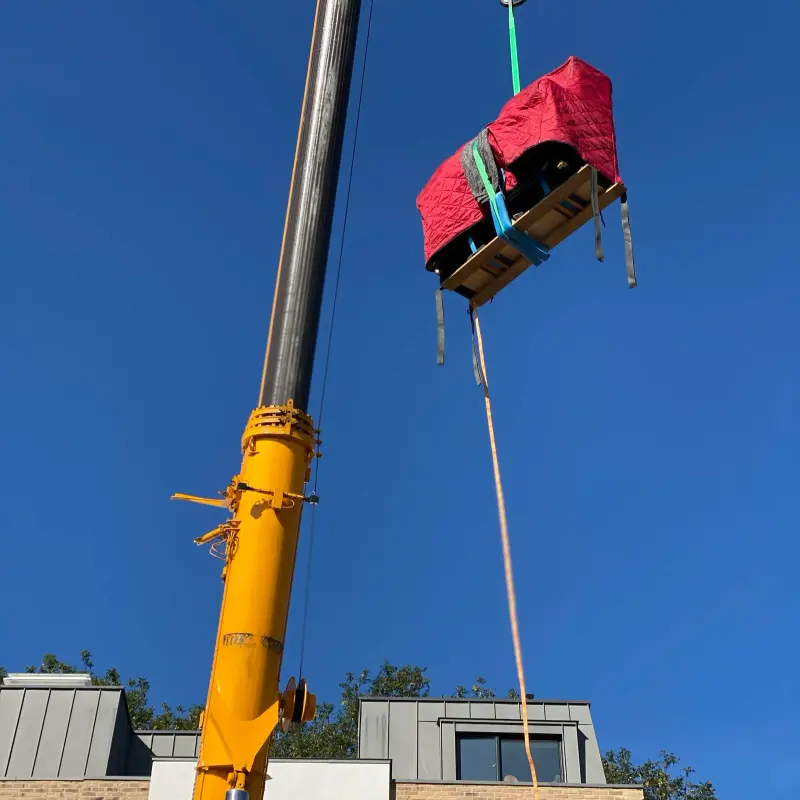
A specialist piano mover runs planned routes, not ad hoc trips, which means availability on specific dates can fill up. Booking a week or more in advance is reasonable for most moves. For moves around the end of a month, which is the busiest period for house completions, or for moves involving a crane lift, earlier is better. The available dates for your postcode area are shown at book.pianospeed.com when you enter the details.
Can I ask for references from a piano moving company?
You can, and a specialist with a genuine track record will have them. For PianoSpeed, the public record is the Trustpilot profile, rated 4.9 out of 5 from 77 reviews, all from real piano moves. Reading the reviews gives a more reliable picture than a curated reference list, because the reviews are from customers who submitted them independently.
What should I tell the company when I call or book online?
The piano type and model name if you know it, the finish, the floor level at both addresses, whether there is a lift, the approximate width of the staircase if there are stairs, and whether there are any doorways that might be tight for a piano. This information lets the company plan the crew size and method accurately. At book.pianospeed.com the form prompts you through each detail.
For a fixed price on your piano move, go to book.pianospeed.com and enter the piano type and the access details at both addresses. Piano moves start from £125. You can also call 020 7164 0000 to talk through any access questions before you book. PianoSpeed is rated 4.9 out of 5 on Trustpilot from 77 reviews, all from real piano moves across London, Surrey and the UK. PianoSpeed London Limited, 71-75 Shelton Street, Covent Garden, London WC2H 9JQ.
Book your move in 2 minutes
When it has to arrive perfectly, there is no second choice.
Get an instant quote★★★★★ Rated 4.9 out of 5 on Trustpilot from 77 reviews