
Blog · 28 July 2026
How to measure a room for a piano before delivery
Before a piano is delivered, measure two things: the room where it will live, and the access route it must travel to get there. The room is usually straightforward. The access route is where problems hide. A doorway that looks perfectly wide for everyday life can be narrower than a piano on a padded skid board needs, and a corridor that feels comfortable to walk through can have a tight turn that stops the crew in their tracks. Check both now, flag any questions when you book at book.pianospeed.com, and the delivery day will go to plan.
Piano dimensions: the numbers to work from
Your first step is to confirm the dimensions of the specific piano being delivered. Make and model matter, because a Yamaha U1 is a different shape to a Steinway Model B, and a Kawai baby grand is different again from a Bechstein A. The dealer or manufacturer can confirm the exact figures if you do not have them.
Upright pianos typically measure:
- Width (keyboard side to side): 135 to 155 centimetres
- Depth (front of keys to back of case): 50 to 70 centimetres
- Height: 90 to 132 centimetres, depending on the model
Baby grand pianos typically measure:
- Width: 148 to 153 centimetres
- Length (keyboard end to tail): 148 to 170 centimetres
- Height to lid when closed: around 100 centimetres
Full grands range from 170 to 230 centimetres in length at a width of around 150 centimetres. Concert grands reach 270 to 305 centimetres in length. A specialist piano mover always asks for the make and model before the job, because they use those figures to plan tight corners and doorways before the day.
How much floor space the piano needs in the room
The piano needs floor space to stand plus clearance around it for playing, maintenance and tuning. A piano pushed hard against a wall with no gap behind it is harder to tune, and for grands the lid cannot open fully to either position without clearance at the treble end.
For an upright piano, a practical minimum is the instrument's own depth plus at least 60 centimetres at the keyboard end for the player. An upright that is 62 centimetres deep needs at least 122 centimetres of total depth from the wall behind it to the nearest chair, furniture or wall in front. Add a gap of 5 to 15 centimetres between the back of the piano and the wall: placing an instrument directly against cold masonry or an exterior wall is bad for the soundboard and the action. Allow at least 30 centimetres each side for the tuner to access the back and for pulling the piano forward when needed.
For a grand piano, the length of the instrument drives the room requirement. A baby grand at 165 centimetres long needs at least 225 centimetres of clear floor length once you include the keyboard overhang and walking room at the tail. Measure the longest uninterrupted floor run in the room. If there is a bay window, the recess often adds just enough length to make a grand work in a space that would otherwise be too tight.
Measuring the access route
Measure every section of the route the piano will travel: from the street, through the entrance, along every corridor, through every door and up or down any stairs, to the room where it will stand. Write each measurement down separately.
Doorways
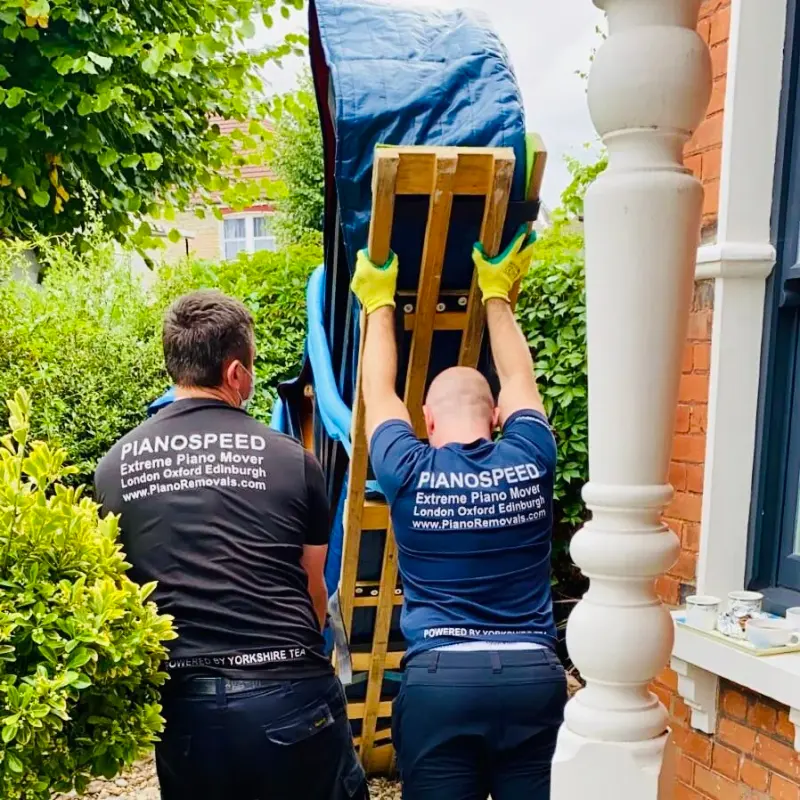
A standard UK internal door has a clear opening of around 762 to 826 millimetres. An upright piano is 135 to 155 centimetres wide, so it cannot pass through a doorway at its full width; the crew carries it at an angle on a padded skid board. In practice, most standard upright pianos pass through a doorway that is at least 78 centimetres wide if the room in front allows turning. For a grand, the case travels on its side with the legs removed; the crew needs the door width and height confirmed in advance to plan the method. For every door on the access route, measure the clear opening width from frame to frame, not door to stop, and note the height. Check whether the door can be removed from its hinges; removing a door is often the simplest approach on tight access points.
Corridors and hallways
A corridor needs enough width for the piano to be tilted and turned as it passes through. For an upright piano, a clear unobstructed width of at least 90 centimetres gives the crew room to manage the angle. Note the narrowest point in the corridor, which is often where a dado rail, a radiator or a projecting staircase newel post reduces the usable width.
If the hallway has a 90-degree or tighter turn, measure the inside corner and the wall opposite. The crew needs to understand how much turning space is available at that point. A long upright in a tight L-shaped hallway is manageable with specialist equipment, but only if the crew knows about it in advance.
Stairs
For a piano going to a floor above or below street level, measure the stair flight width, the headroom at the lowest point above the stairs, and the depth of any landing or turning platform between flights. Stair access is chargeable and is calculated automatically in the online quote at book.pianospeed.com when you enter the floor level at each address. The crew uses stair-climbing equipment for safe, controlled handling on steps, and they need the stair dimensions before the job to plan the approach.
Ceiling height on the staircase
In a standard room, ceiling height is rarely a concern for an upright piano delivery. On a staircase, the ceiling above the lower part of the flight is often lower than the main ceiling height, and in older terraced houses or basement conversions it can drop to 180 centimetres or less. When the piano is tilted to travel down the flight, it gains effective height at one end. Measure the minimum headroom above the staircase and give that figure to the mover when you book. The same applies to low doorways in cottage-style properties and period basements.
What to do if your measurements raise a question
If you are measuring a doorway or corridor and are not sure whether the piano will fit, write down the numbers and contact PianoSpeed before confirming the delivery date. An experienced specialist can often confirm from the measurements alone whether a standard approach works or whether an alternative needs planning: removing a door from its hinges, using a different entrance, or arranging a crane lift through a window. A crane lift is a separate service, arranged and priced in advance; it is used for pianos going to upper floors where the staircase cannot accommodate the instrument. Measuring in advance and sharing the figures when you book is what allows the specialist to plan the job properly before the crew sets out.
Common questions about measuring for a piano delivery
What is the minimum corridor width for an upright piano?
Around 90 centimetres of clear, unobstructed corridor width gives a specialist crew room to tilt and manoeuvre an upright on a padded skid board. The critical measurement is the narrowest point, often where a newel post, radiator or turn reduces the usable width. If it is narrower than that, mention it when you book so the crew can plan the approach.
Will a standard UK internal door let an upright piano through?
A standard UK clear door opening of 76 to 83 centimetres will allow a specialist crew to pass most upright pianos through at an angle. The crew may remove the door from its hinges to gain the full opening. If your opening is narrower than 76 centimetres, flag it when you book. For a grand in transit position, the dimensions are different and need to be assessed separately.
How much space does a piano need behind it against a wall?
A gap of 5 to 15 centimetres between the back of the piano and the wall is enough to allow air movement and is better for the instrument than direct contact with cold masonry or an exterior wall. Some tuners prefer a slightly larger gap for access, so 15 to 20 centimetres where the room allows is worth doing.
Does ceiling height matter for a piano delivery?
In a room with a normal ceiling it is rarely the constraint. On a staircase with low headroom or in a basement conversion it can be decisive. Measure the minimum headroom above the staircase and give that figure to the mover when you book.
What if a grand piano is too long for my room?
A bay window often provides just enough extra depth to make a grand fit in a room that is otherwise too short. If there is no recess available, a shorter model may be the answer. PianoSpeed delivers and collects grands in London, Greater London, Surrey and across the GB mainland; getting the room measurements confirmed before choosing the instrument is the straightforward way to be certain it fits.
Book a specialist piano delivery
Piano moves start from £125. For a fixed price with access and stairs priced in, get an instant quote at book.pianospeed.com. If you have access questions before you book, call 020 7164 0000 and the team will work through the measurements with you. PianoSpeed is rated 4.9 out of 5 on Trustpilot from 77 reviews. PianoSpeed London Limited, 71-75 Shelton Street, Covent Garden, London WC2H 9JQ. Part of the Pianospeed Group.
Book your move in 2 minutes
When it has to arrive perfectly, there is no second choice.
Get an instant quote★★★★★ Rated 4.9 out of 5 on Trustpilot from 77 reviews