

Blog · 11 August 2026
Moving a digital piano or Clavinova safely: upright packing vs acoustic handling
Moving a digital piano or Clavinova safely comes down to three things: keeping the instrument upright throughout the journey, protecting the electronics and cabinet finish from vibration and contact marks, and removing the legs and pedal unit before the cabinet leaves the room. The handling method is different from moving an acoustic upright in several specific ways, and it differs from moving a grand piano entirely. For a fixed price on moving your digital piano or Clavinova, go to book.pianospeed.com or call 020 7164 0000.
Digital pianos travel upright, not on their side
A grand acoustic piano travels on its straight side on a padded skid board for the journey. A digital piano does not. A Yamaha Clavinova, Roland LX or HP series, Kawai CA or CN series, or any full-cabinet digital instrument travels in its normal orientation: upright, padded in a fitted transit cover, on a piano board, and secured in the vehicle without being tipped. The amplifiers, speaker units and digital action mechanism inside a cabinet digital piano are not designed to be transported on their side, and tipping one for transit risks damage to internal components that an acoustic instrument would not be vulnerable to.
This is the clearest practical difference between moving an acoustic upright and a digital cabinet instrument. The shape and wrapping method look similar from the outside, but the orientation in transit is not the same, and a crew that does not know this will handle the job incorrectly from the outset.
Removing the legs and pedal unit
Most full-cabinet digital pianos, including the Yamaha Clavinova CLP and CVP series, the Roland LX and HP series, the Kawai CA and CN series and the Korg G1 Air, have legs and a pedal unit that unbolts from the main body. At the collection address, the crew removes the legs and pedal unit before the cabinet is padded and loaded. The process is straightforward but requires the right tools and knowledge of how each manufacturer's fitting points work. A crew unfamiliar with the instrument will sometimes attempt to carry it assembled, putting unnecessary stress on the leg attachment points and risking damage to the casing around them.
The legs and pedal unit are padded and stowed separately in the van. The cabinet alone is still a substantial piece of furniture, and the crew uses a padded piano board to move it through the property safely, keeping it clear of door frames, walls and stair handrails throughout.
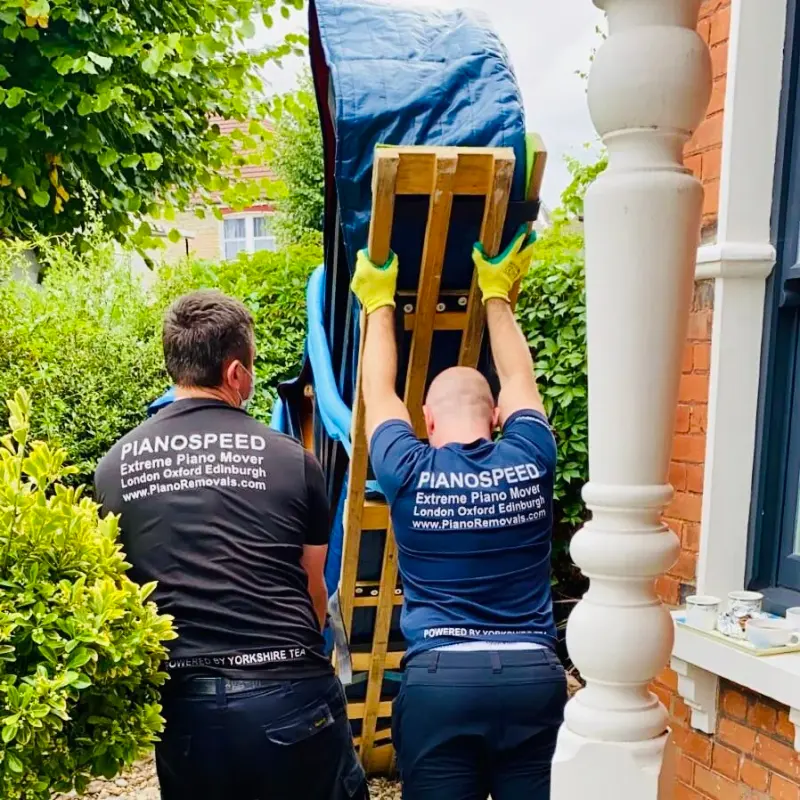
Protecting the electronics and cabinet finish
A full-cabinet digital piano has amplifiers and speaker units built into the body. They are sensitive to impact and vibration in ways that a solid acoustic soundboard is not. The triple-thickness fitted transit cover that goes on before the cabinet moves sits flush against the polished lacquer or satin finish without pressure points, and it cushions against road vibration throughout the journey. PianoSpeed uses fitted covers, not loose blankets, on every instrument.
The display panel, music rack and any protruding controls are checked before the piano leaves the room. Where a display or rack protrudes and is at risk during a doorway passage or staircase, padding is added before the cabinet is moved. Nothing loose, including the music rack, cables, accessories or the bench, travels inside the cabinet during the move. The instrument is disconnected from power and all cables are removed or secured before it leaves the collection address.
Portable keyboards and stage pianos: a different job
A portable or semi-portable digital piano, such as a Roland FP or RD series, a Yamaha P series or a Kawai ES series, is a different kind of instrument. These have lightweight chassis, no fixed wooden cabinets and no built-in amplification of the same scale as a Clavinova. They are moved as general electronic equipment rather than as specialist piano equipment, and a dedicated piano mover is not always the right choice for them.
If you are not certain which category your instrument falls into, the test is practical: does it have a fixed wooden cabinet with built-in speakers, a separate pedal unit that bolts underneath, and legs? If yes, treat it as a full-cabinet digital piano and use a specialist. If it is a keyboard mounted on a separate metal X-stand or Z-stand, it is a lighter job. Call 020 7164 0000 if you want to confirm which service is right for your specific instrument.
Stairs and access for a digital piano
Cabinet digital pianos go up and down stairs regularly. The cabinet without its legs is narrower than a full acoustic upright, which makes many Victorian and Edwardian staircases more manageable. The combined weight of the cabinet, legs, pedal unit and bench is still significant for any high-end Clavinova or Roland LX, and stairs remain a minimum two-person job throughout.
Stairs are chargeable. The stair charge is calculated automatically at book.pianospeed.com when you enter the floor level and whether a passenger lift is available. Where the stairwell is particularly tight or has a sharp half-landing turn, the access should be described accurately when you book so the method can be confirmed before the day rather than discovered on arrival.
What to tell the specialist when you book
Accurate information at the time of booking makes the price reliable and the crew correctly prepared. When booking a digital piano move, tell the specialist:
- The make and model (Yamaha Clavinova CLP-785, Roland LX708, Kawai CA99, Korg G1 Air and so on).
- Whether the legs and pedal unit unscrew from the cabinet.
- The finish: polished black, high-gloss white and premium lacquers need particular care when the transit covers are placed.
- Access at both ends: number of stairs, floor level, whether a passenger lift is available and its internal dimensions, and doorway widths.
- Whether the instrument has been disassembled before, as this confirms the fitting points are accessible and undamaged.
With accurate access information, the price you see at book.pianospeed.com is the price you pay on the day. There are no adjustments on arrival when the details are entered correctly.
Frequently asked questions
Does a digital piano or Clavinova always travel upright?
Yes. A full-cabinet digital piano or Clavinova is never transported on its side. The electronics, amplifiers and speaker units inside the cabinet are not designed to be moved that way. The instrument travels padded and secured in its upright orientation throughout the journey, which is one reason a specialist piano mover handles it differently from a general removals firm.
Does a Clavinova need a specialist piano mover, or can a general removal firm do it?
A Clavinova or full-cabinet digital piano needs a crew that knows how to remove the stand and pedal unit correctly, wrap the cabinet without marking the finish, and carry the instrument upright on a padded board rather than tilting it. A general removal firm handles it as furniture. For an instrument that contains sensitive electronics and a polished wooden cabinet, that difference in approach is worth paying attention to.
Will my digital piano be disconnected from power before the move?
Yes. The instrument is disconnected from power and any cables are removed or secured before the piano leaves the collection address. The crew checks this as part of their preparation at the collection point, before the transit cover goes on.
Can a Clavinova go up a narrow Victorian staircase?
The cabinet of a Clavinova without its legs is narrower than a full acoustic upright, which helps on tight staircases. Whether a particular staircase works depends on its width, the ceiling height at the top of the flight and any half-landing turn. Enter the access details at book.pianospeed.com and the booking team will confirm the method before the day. Stairs are chargeable and the cost is included in your instant online quote.
What is the difference between moving a digital piano and an acoustic upright?
The main differences are orientation in transit and what is removed beforehand. An acoustic upright travels upright on a trolley in its assembled form in most cases. A digital piano travels upright too, but with the legs and pedal unit removed and packed separately, because those fixings are intended to be detached rather than to bear the loads of a move. A digital piano also has internal electronics that need protection from vibration in ways a solid acoustic body does not.
Does a digital piano need tuning after it is moved?
No. A digital piano does not use tuning pins, a pin block or a soundboard in the same way an acoustic instrument does. Moving it does not change the pitch. However, it is worth powering the instrument on and testing all keys and functions once it has been reassembled and reconnected at the destination, to confirm everything is working as expected.
For a fixed price on moving your digital piano or Clavinova, go to book.pianospeed.com and enter the make, model, finish and access details at both ends. Piano moves start from £125. You can also call 020 7164 0000. PianoSpeed is rated 4.9 out of 5 on Trustpilot from 77 reviews, all from real piano moves across London, Surrey and the UK. PianoSpeed London Limited, 71-75 Shelton Street, Covent Garden, London WC2H 9JQ, part of the Pianospeed Group.
Book your move in 2 minutes
When it has to arrive perfectly, there is no second choice.
Get an instant quote★★★★★ Rated 4.9 out of 5 on Trustpilot from 77 reviews