
Blog · 29 July 2026
Moving or donating a piano after a bereavement
When someone close to you dies and they owned a piano, the instrument is often one of the hardest things to work out what to do with. It cannot go to a charity shop. It is heavy, fragile, and it carries decades of memory. Whether the piano ends up staying in the family, going to a school or hospice, or being collected by a specialist dealer, it will need a specialist crew to move it safely. This guide is for anyone in that situation.
If you already know where the piano is going and want a fixed price, the instant online quote at book.pianospeed.com covers the full move. Piano moves start from £125. You can also call 020 7164 0000.
The three main options: keep, donate or sell
Most families settle on one of three outcomes. Keeping the piano in the family is the most common, whether that means moving it to a family member's home, a grandchild who is learning, or a sibling who played. The second option is donating it to somewhere it will be used: a school, a hospice, a church, a community hall or a music charity. The third is selling it through a specialist piano dealer or auction house, which is worth considering if the instrument is valuable or if no-one in the family can offer it a good home.
A fourth outcome exists, though it is rarely the right one: disposal. A piano that is genuinely beyond economic repair can be broken down and disposed of, and a piano technician can confirm whether that is actually the case. Pianos that appear neglected are often still playable with attention, so a technician's opinion is worth getting before you write one off.
Getting a valuation before you decide
Before any decision is made, it is worth knowing what the piano is worth. A general estate agent will not give you a reliable figure. A piano technician, a specialist piano dealer or a specialist auction house can provide a written valuation. This matters for two reasons. It establishes the insurance level you need for any move, and it tells you whether the instrument is worth the cost of a specialist move or whether a donation with the recipient collecting it is the more practical outcome.
Many Victorian and Edwardian uprights that look imposing are worth relatively little on the open market, while a good-quality mid-century upright or a baby grand from a respected maker can be worth considerably more than the family expects. The valuation removes the guesswork.
Finding the piano a good home through donation
If no family member wants the piano and it is in playable condition, donation is often the right choice. The instrument goes somewhere it will be played, and the estate avoids the cost of selling.
The most reliable recipients for a donated piano are:
- Primary and secondary schools, especially those without their own instrument
- Hospices and care homes, where a piano in a common room is genuinely used
- Churches and community halls that host local music groups
- Music charities working with young people in areas with limited access to instruments
- Amateur orchestras, choral societies and brass bands with a rehearsal space
The practical point to know is that in most cases, the recipient organisation arranges and pays for collection once you have agreed to donate. Some schools have their own removals contacts; others will ask you to recommend a specialist. If the organisation does not have a suitable crew and you would rather arrange the collection yourself, the booking team at PianoSpeed can discuss that.
If the estate is not yet settled
If probate has not yet been granted, the executor does not have formal authority to sell or donate estate assets. Moving the piano into specialist piano storage for safekeeping while the estate is being administered is generally acceptable, and many solicitors will confirm this in writing before you proceed. If you are uncertain, check with the solicitor handling the estate before booking a move or agreeing to a donation.
Leaving a piano in an empty property for an extended period carries its own risks: theft, humidity change and the standard household insurance cover may not be adequate for a valuable instrument. Specialist piano storage is often the sensible short-term answer. The sister site pianostorage.co.uk provides climate-controlled piano storage and can arrange collection from the estate property.
Moving the piano to a family member's home
If a family member is taking the piano, the move is booked and paid from the estate as a reasonable administration expense in most cases, though confirming this with the solicitor is good practice. The crew collects from the deceased's property and delivers to the new address. Both addresses need to be ready and accessible on the day.
When you book, tell the team about access at both addresses. How many floors, whether there is a lift, and whether there are any tight staircases all affect the job. Access including stairs and floor level is priced automatically in the online quote at book.pianospeed.com, so the price you see is the price you pay. Give the booking team as much notice as possible about difficult access: a Victorian terrace with a turning staircase needs the right equipment planned in advance.
How the piano is protected during the move
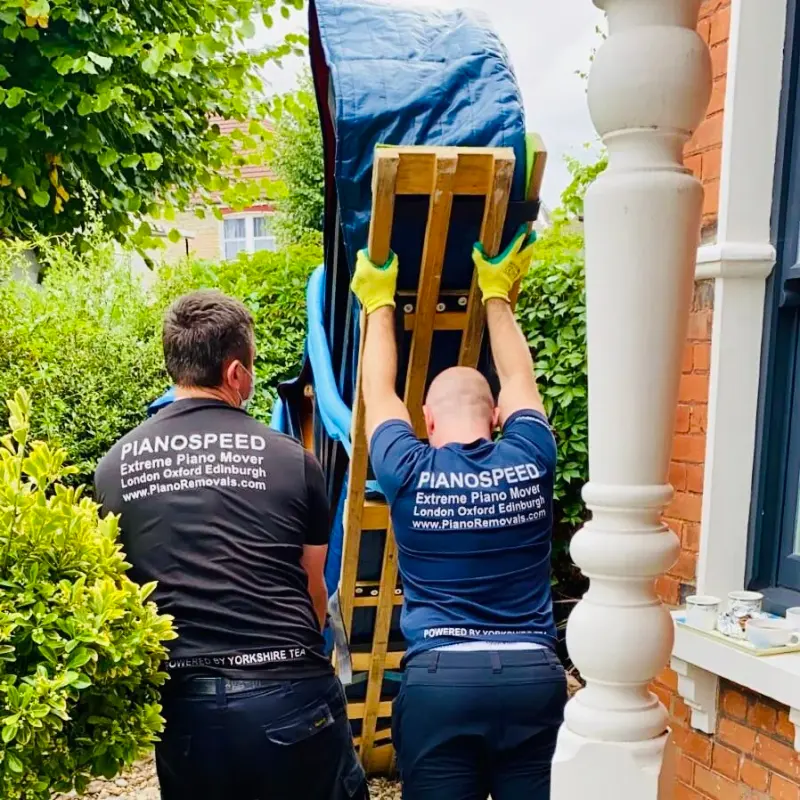
Every piano we move travels in a top-of-range, triple-thickness fitted transit cover. On a grand or baby grand, the legs and pedal lyre are removed, each going into individual padded bags, before the body goes into a heavy-duty crate. Every piano travels on a padded skid board and is strapped securely in the vehicle. This is specialist work that a general removal firm does not carry out.
If you are moving an older or antique upright, tell the booking team the age and make when you book. Victorian and Edwardian instruments can have fragile casework, decorative elements and veneer that needs extra care.
Frequently asked questions
Do I need a specialist to move a piano after a bereavement?
Yes. Pianos are heavy, top-heavy when upright, and fragile in ways that general removals firms are not equipped to handle. An upright can weigh 200 to 500 kg. A specialist crew uses padded skid boards, stair-climbing equipment and fitted transit covers. A general van and a few friends is how pianos get dropped and damaged.
How soon after a bereavement can I arrange a piano move?
There is no set waiting period. The practical constraint is probate: if the piano is an estate asset and probate has not been granted, you should take legal advice before selling or donating it. Moving it to storage while you decide is generally straightforward. If probate is already granted or if the piano is being kept in the family, a move can be booked as soon as you are ready.
What if no-one in the family wants the piano?
Donation to a school, hospice, church or music charity is usually the best outcome. A piano technician can advise you on whether the instrument is in good enough condition to be playable, which affects how easy donation will be. If the piano is genuinely unplayable and beyond economic repair, the technician can also advise on disposal options.
Can the recipient collect the piano if we are donating it?
In most cases, yes. A school or community organisation with a suitable removals contact will arrange their own collection. Make sure they are using a piano-trained crew, not a general removals firm, and that they have appropriate insurance for the move. If you would prefer to arrange the collection yourself, PianoSpeed can book and manage the move to the recipient.
How do I know whether the piano is worth keeping?
A written valuation from a piano technician or specialist auction house will tell you. Many older uprights have limited monetary value but considerable sentimental and practical value to a family member who wants to play. If anyone in the family plays or is learning, keeping it is usually the right outcome regardless of monetary value.
What happens to the piano if it is on an upper floor?
Stairs and floor level are priced automatically in the online quote at book.pianospeed.com. Access including stairs is chargeable and calculated when you book. For very tight staircases or properties where the piano cannot go over the stairs, a crane lift can be arranged.
Booking a move for a piano in a bereavement situation
The team at PianoSpeed handles bereavement moves regularly and understands the practical constraints of an estate. For a fixed price, go to book.pianospeed.com or call 020 7164 0000. PianoSpeed London Limited, 71-75 Shelton Street, Covent Garden, London WC2H 9JQ, is rated 4.9 out of 5 on Trustpilot from 77 reviews. For specialist piano storage while the estate is being administered, go to pianostorage.co.uk. Part of the Pianospeed Group.
Book your move in 2 minutes
When it has to arrive perfectly, there is no second choice.
Get an instant quote★★★★★ Rated 4.9 out of 5 on Trustpilot from 77 reviews