
Blog · 30 August 2026
Moving a piano into a loft conversion: access challenges and what the crew does
A standard upright piano can go into most London loft conversions, but the access challenges are more complex than a standard two-floor stair carry. Loft stairs are typically steeper, often narrower, and almost always have restricted headroom at the top. Before a specialist crew confirms the job, three specific measurements at your loft determine whether a carry is viable and which method to use. For a fixed price that accounts for the floor level and stair access at both addresses, get an instant quote at book.pianospeed.com.
Why loft stairs are harder than the main staircase
Most domestic main stairs are built to standard proportions: a pitch of around 35 to 38 degrees and a clear width sufficient for two people to pass. Loft conversion stairs are typically steeper, often reaching 42 to 45 degrees, and narrower, sometimes as little as 650 millimetres clear width. These dimensions reflect the compromise made when creating a staircase in a space not originally designed for one.
Steeper pitch matters for a piano carry because the instrument has to be tilted to match the angle of the flight. On a 35-degree main stair, the piano leans forward at an angle the crew can control comfortably. On a 44-degree loft stair, the same instrument is much closer to vertical, and the load distribution on each crew member changes significantly. The centre of gravity of an upright piano sits higher in the case than most people expect, which makes a steep pitch more demanding to hold steady throughout the carry.
Narrow width adds to this. On a tight flight, the crew cannot stand beside the piano; they work one at the top and one at the bottom with the instrument between them, rather than spreading around it. This reduces the number of contact points available to control the load.
The three measurements that determine whether the job is viable
Before confirming a loft piano move, a specialist crew needs three things: the stair width at the narrowest point, the headroom at the top of the stairs measured from the top tread to the ceiling directly above it, and the standing height at the position where the piano will live inside the loft room.
- Stair width: measure the clear width between walls or between a banister and a wall at the narrowest point on the flight, typically where a handrail bracket or newel post reduces the opening
- Headroom at the top step: stand on the top tread and measure from the surface of the tread to the ceiling or sloped roof directly above; this is the critical dimension for bringing the piano over the last step
- Standing height at the piano position: measure the clear height at the exact spot where the piano will stand permanently and compare it to the height of your instrument
- Make and model: the manufacturer's stated dimensions give the crew the specific height, width and weight they are working with before the van leaves
Share all four when you book. The more complete the picture at the outset, the less likely it is that the crew arrives and finds a problem that could have been anticipated.
Which pianos can realistically go into a loft conversion
The answer depends on the piano's height and the headroom at the top of the loft stairs. The ceiling height inside the room matters for where the piano will stand permanently, but the critical constraint for getting the instrument up there is the space at the top of the flight as the piano comes over the last step and is lowered back to horizontal.
- Compact studio uprights (around 108 to 115 centimetres tall): fit most loft conversions that have reasonable headroom at the top of the stair
- Standard uprights (117 to 122 centimetres): viable in most loft conversions with at least 2 metres of clear headroom at the top step
- Full-size uprights (124 to 135 centimetres): need the headroom at the top step assessed individually before the job is confirmed
- Tall uprights (over 135 centimetres, including some Bechstein and Grotrian models): tight on most loft stairs and require a detailed access assessment
- Baby grand and grand pianos: rarely viable inside a loft room because the pitched ceiling leaves insufficient height at the position where the instrument would need to stand; exceptions exist for conversions with a large central dormer and a high ridge
The stair carry and the exterior crane lift
For most compact and standard uprights going into a loft with workable access, a stair carry is the right method. The crew wraps the piano in triple-thickness fitted transit covers, places it on a padded skid board and carries it up the flight in a coordinated lift-and-step pattern. Two to three people handle the loft stair section, with the crew size determined by the pitch, the clear width and the weight of the specific instrument.
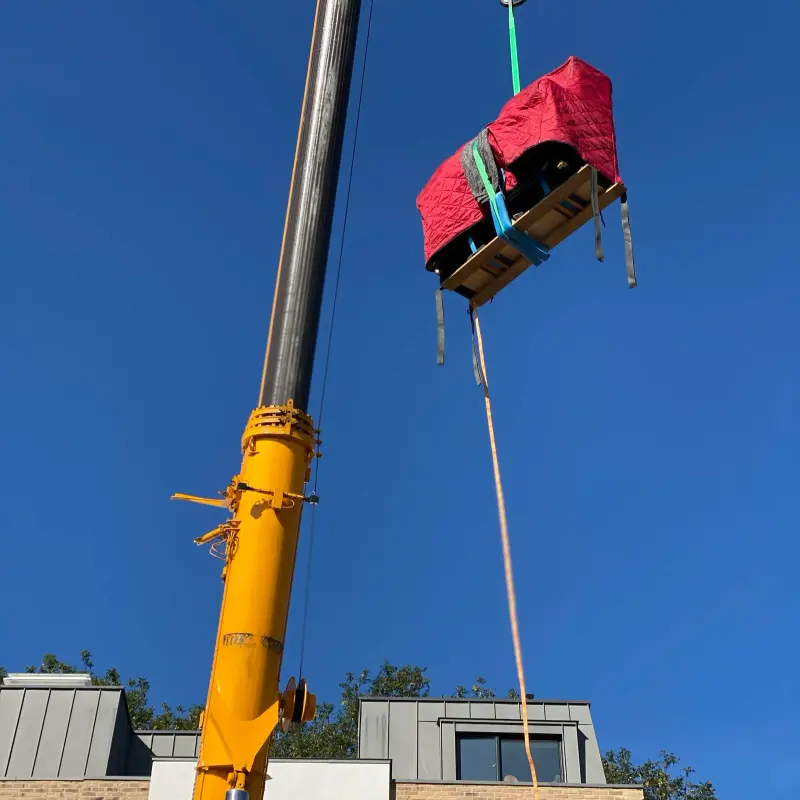
When the stair geometry rules out a carry, the alternative is an exterior crane lift: hoisting the piano on a rig outside the building and bringing it in through a large opening such as a Velux hatch or a dormer window. This requires the window opening to be large enough for the instrument body. A standard Velux hatch with an internal opening of around 78 by 98 centimetres is borderline for a compact upright; a full dormer window is more workable. A crane lift also requires a site assessment before the job to confirm the rig position and any required arrangements for access to the outside of the building.
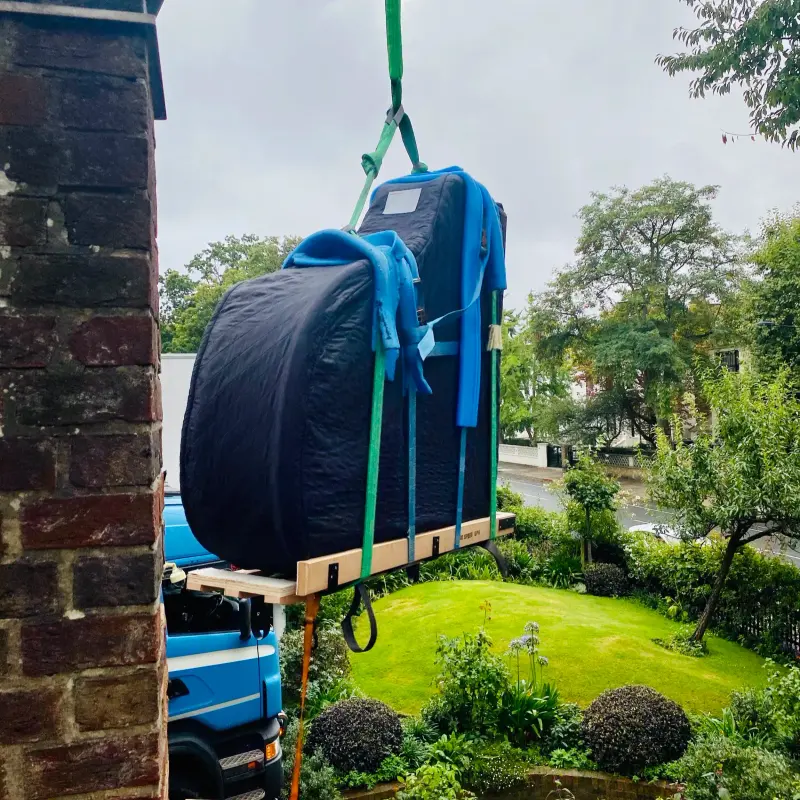
Crane lifts add cost and complexity compared to a stair carry and are not the first choice. They are the right answer when the stair access genuinely does not work, not a way around a staircase that is tight but manageable. Part of the specialist crew assessment is determining which method applies to your specific job.
Ceiling pitch inside the loft room
Getting the piano into the loft is only half of the problem. The pitched ceiling inside a loft conversion means the usable height varies across the room. At the ridge it may be 2.4 metres or more. At the knee walls, where the sloped ceiling meets the vertical wall panels, it may be 1.5 metres or less. A standard upright needs around 1.35 to 1.45 metres of clear height to stand, with a small margin for lifting it off its castors to position it correctly.
This means the piano can only stand in the zone of the loft room where the ceiling is high enough. In a typical double-pitched loft, this is the central section running along the ridge. If your loft has a flat section with a dropped beam or a bulkhead, measure the height at that specific point. In some loft rooms the only viable standing position for an upright is directly under the ridge, and the piano must be planned in before the room is fitted out rather than moved in afterwards.
What to measure and check before you book
- Clear stair width at the narrowest point on the loft flight, including any handrail intrusion
- Headroom from the top tread to the ceiling or sloped roof directly above it
- Ceiling height at the exact position where the piano will stand inside the loft room
- Make and model of the piano, with the manufacturer's stated height and width
- Internal opening dimensions of any Velux or dormer window, in case a crane lift assessment is needed
- Whether your building or a residents management company requires advance notice for an upper-floor delivery
Clear the loft stair of any stored items before the move day and remove any stair runner or loose matting, which creates a slip hazard under load. On a tight loft stair, the route needs to be fully clear before the crew starts.
Questions about moving a piano into a loft conversion
Can a grand piano go into a loft conversion?
Rarely. A baby grand with the legs removed is roughly 120 to 150 centimetres wide at the body and needs around 2.2 metres of ceiling height at the position where it will stand to allow the legs to be reattached underneath. In a standard pitched loft conversion this headroom exists only near the ridge, and the usable floor space there is limited. If you are planning a music room in a loft, a compact upright is almost always the more practical choice.
Is moving a piano to a loft more expensive than a standard stair carry?
Stair access is chargeable on all moves, and loft stairs are assessed based on the floor level at the delivery address. Piano moves start from £125. The full cost including stair access, both floor levels and the instrument type is calculated automatically when you enter the details at book.pianospeed.com. The price you see is fixed before you confirm.
What if the piano will not fit up the loft stairs?
If the stair width or headroom rules out a manual carry, a crane lift via a Velux or dormer window may be viable. If that opening is also too small, the piano cannot go into the loft by any method. A specialist crew can confirm this from your measurements before the job is booked. It is worth establishing this early, particularly if you are planning a music room as part of a loft conversion and the piano is part of the brief.
Do I need a site visit before the move day?
Not usually. The crew works from the access details you provide at booking. If you can supply the stair width, headroom at the top step, ceiling height at the piano position and the piano make and model, a preliminary visit is rarely necessary. For genuinely unusual access, including very restricted headroom, a steep spiral staircase or a crane lift requirement, PianoSpeed will confirm the approach before the move day rather than leaving it as an assumption.
How long does moving a piano into a loft take?
The loft stair section typically takes 20 to 40 minutes for a compact or standard upright, depending on the stair geometry and the crew size. A crane lift, including rig setup, the hoist and positioning inside the room, takes longer and is arranged as a separate job type. Total move time depends on the floor level at collection, the distance and the access at both addresses.
Get a fixed price for your loft piano move
Piano moves start from £125 and stair access to a loft is priced automatically in the online quote. For a fixed price covering your instrument, the access at both addresses and a confirmed date, get an instant quote at book.pianospeed.com. If you have an unusual loft staircase or want to discuss a crane lift before booking, call 020 7164 0000. PianoSpeed London Limited, 71-75 Shelton Street, Covent Garden, London WC2H 9JQ, is rated 4.9 out of 5 on Trustpilot from 77 reviews.
Book your move in 2 minutes
When it has to arrive perfectly, there is no second choice.
Get an instant quote★★★★★ Rated 4.9 out of 5 on Trustpilot from 77 reviews