
Blog · 16 August 2026
Why a self-storage unit is the wrong place for a piano
A standard self-storage unit is not the right place for a piano. The environment inside a typical self-storage facility changes with the weather: damp in winter, warm and dry in summer, and often poorly ventilated throughout the year. Pianos are built from wood, felt, metal and leather, and they are sensitive to exactly these conditions. Putting an upright, baby grand or grand piano in a standard storage unit for more than a few weeks carries a real risk of lasting damage. The specialist alternative is pianostorage.co.uk, the sister site of the Pianospeed Group, which provides climate-controlled specialist piano storage with collection and redelivery handled by piano-trained crews.
What an uncontrolled storage environment does to a piano
Humidity is the biggest threat. When the air inside a storage unit gets damp, a piano's wooden soundboard absorbs moisture and swells. When the air dries out, the board shrinks. Repeated cycles of swelling and shrinking crack the soundboard along the grain, separate glue joints in the case and bridge, and can cause the bridges to lift or split. These are not cosmetic problems: a cracked soundboard changes how the piano sounds and can be expensive or impossible to repair fully.
Temperature swings compound the problem. As the pin block expands and contracts with heat and cold, the tuning pins lose their grip and the piano goes out of tune faster than normal. Steel strings rust in damp air. Action parts made from felt, leather and thin wooden components warp and lose their regulation. A piano that goes into a standard storage unit tuned and playing well will often come out needing tuning, action regulation and possibly more significant repair work.
- Soundboard cracks along the grain from repeated humidity cycles
- Glue joints open in the case, bridges and pin block
- Strings corrode and lose brightness in damp conditions
- Felt and leather action parts warp or compress under temperature extremes
- Tuning instability caused by pin block movement
The access problem: getting a piano into a storage unit safely
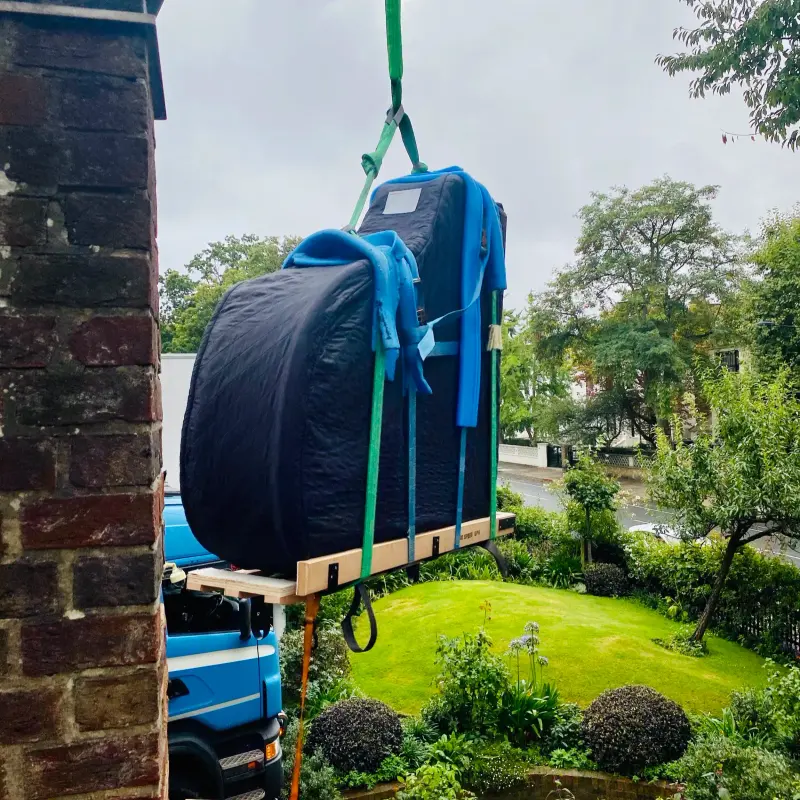
Standard self-storage facilities are not built for pianos. The corridors, lifts and doorways in a typical facility are designed for boxes and flat-pack furniture, not for an instrument that can weigh anything from 150 kg for a small upright to over 500 kg for a concert grand. Moving a piano through narrow corridors and around tight corners without a skid board, specialist fitted transit covers and a trained crew is how pianos get dropped, scratched or structurally damaged.
Even if you manage to get the piano into the unit, the storage position matters. A piano left on a hard concrete floor without a protective board underneath it is resting on its casters or feet in a way it was not designed to sustain over months. If it tips or shifts because something is leant against it, the damage can be immediate and serious.
What specialist piano storage looks like
A specialist piano storage facility is climate-controlled and humidity-monitored throughout the year. The target range is typically 45 to 55 per cent relative humidity, which is close to what a well-managed domestic environment provides. The temperature is stable rather than reactive to the outside air. Pianos are stored on specialist racking rather than on a bare floor, and each instrument stays wrapped in its fitted transit cover rather than being unwrapped and exposed to the storage environment.
Specialist piano storage is handled by pianostorage.co.uk, the sister site of the Pianospeed Group. The facility accepts uprights, baby grands, grands, concert grands and digital pianos including Clavinovas. Collection from your address is carried out by a piano-trained crew using the same equipment and vehicles used for standard piano moves. When you are ready for the piano to come back, you book a redelivery through the same system.
How a piano move into storage actually works
The process is simpler than most people expect. A piano-trained crew collects the instrument from your address, wraps it in triple-thickness fitted transit covers, loads it securely on a padded skid board in the vehicle, and delivers it to the climate-controlled storage facility. You do not commit to a redelivery date at the time of booking: when you are ready, you make a second booking for the piano to be brought to you.
- Get an instant fixed price at book.pianospeed.com for the collection leg
- Access including stairs and floor level is priced automatically in the online quote
- The crew uses the same specialist equipment as on any piano move
- The piano stays wrapped and protected throughout its time in storage
- Book the redelivery separately when you know your destination and date
Piano moves start from £125. The exact fixed price for collection and delivery to storage is at book.pianospeed.com. Storage charges are separate and set by pianostorage.co.uk.
If your piano is already in a standard self-storage unit
If the piano has only been in self-storage for a short time and the weather has been stable, it may have come to no harm. Have it moved out as soon as it is practical and transferred to specialist storage. Once it is settled in a controlled environment, have it tuned: a piano coming out of a fluctuating environment will almost certainly need tuning, and in some cases action regulation as well. A tuner can also spot early signs of humidity damage that are easier to address before they become serious.
Common questions about piano storage
Can I store a piano in a standard self-storage unit?
Technically yes, but it is not advisable. Most self-storage units are not climate-controlled, which means the humidity and temperature inside the unit track the outside weather. Over weeks and months this causes real damage to a piano's soundboard, action, strings and finish. Specialist piano storage in a climate-controlled facility is the right approach.
How long can a piano safely be in storage?
In a properly climate-controlled specialist facility, a piano can be stored for months or years without damage. In a standard self-storage unit, risks accumulate from the first week. The humidity damage to a soundboard often shows after a single winter in an unheated or uncontrolled space.
What humidity level does a piano need in storage?
Piano manufacturers and conservators generally recommend a relative humidity of 45 to 55 per cent. Below 40 per cent the wood dries out and cracks. Above 60 per cent it absorbs too much moisture and swells. The humidity inside a standard storage unit without climate control often falls well outside this range in UK weather.
Can I access my piano while it is in storage?
This depends on the specific storage facility. The team at pianostorage.co.uk can confirm access arrangements when you enquire. In most cases the piano can be accessed for a brief period by appointment, though it stays wrapped and in the controlled environment except when being collected or delivered.
Is a piano safe on the move to a storage facility?
Yes, provided it is being moved by a specialist crew. Every piano PianoSpeed moves travels in a top-of-range, triple-thickness fitted transit cover. On a grand, the legs and pedal lyre are removed and each goes into an individual padded bag, and the body sits on a padded skid board strapped securely in the vehicle. The transit itself is not the risk: the risk is the long-term storage environment.
For specialist piano collection and delivery to climate-controlled storage, get a fixed price at book.pianospeed.com or call 020 7164 0000. PianoSpeed London Limited, 71-75 Shelton Street, Covent Garden, London WC2H 9JQ, is rated 4.9 out of 5 on Trustpilot from 77 reviews. For specialist piano storage, visit pianostorage.co.uk. Part of the Pianospeed Group.
Book your move in 2 minutes
When it has to arrive perfectly, there is no second choice.
Get an instant quote★★★★★ Rated 4.9 out of 5 on Trustpilot from 77 reviews