
Blog · 27 October 2026
Moving a piano to an auction house or saleroom: what specialists do
Most pianos arrive at auction through an estate clearance, a dealer selling surplus stock, or a private owner who has decided that a specialist sale is the right route. The move is more structured than a standard house-to-house delivery because salerooms run tightly scheduled intake days, require condition documentation, and expect the instrument to arrive ready to lot. A specialist piano mover handles all of this as part of the job. For a fixed price covering your collection address and access, get an instant quote at book.pianospeed.com before you commit to a sale date.
Why pianos go to auction
An estate piano with genuine value is often better served by a specialist sale than by a private listing. Dealers, collectors and institutions monitor the major salerooms, and a well-made upright or grand from a recognised maker can reach buyers through auction who would never see a local private listing. Estate executors working through a probate process sometimes have a duty to realise fair value, which makes the auction route the right default for better instruments.
Dealers periodically thin their stock through sale rooms. Conservatoires and schools occasionally release instruments when their fleet is updated. The origin of the piano changes; the practical requirements of getting it into the saleroom in good condition do not.
What auction house access looks like
Auction houses are not like domestic properties. The largest have dedicated loading bays with height restrictions, require pre-booked delivery slots, and enforce strict intake windows on specific days of the week. A call to the saleroom before arranging transport is always the right first step. The porters' department will confirm the intake day, any vehicle size restrictions and whether they need the instrument photographed before unloading.
Smaller regional salerooms often have more flexible arrangements, but the same principle applies: turning up at an unscheduled time with an unmarked van and expecting to walk a piano through the front entrance rarely works. A specialist piano mover familiar with the major London and regional salerooms will confirm the access details with the venue ahead of the collection day, so nothing is left to chance on the morning.
Condition documentation
When a piano changes hands at auction, condition matters in a way it does not always matter in a private sale. The auction house produces a condition report for the catalogue. Buyers inspect before bidding. If there is a dispute after the sale, the timeline of any mark or defect needs to be clear.
A specialist mover photographs the piano before it is wrapped, notes any pre-existing marks on the transit record, and photographs it again at delivery. This is standard practice rather than an optional upgrade. It protects the seller, the auction house and the buyer, and it means that if a question arises about a cabinet mark, there is a clear record of when it was present and when it was not.
Getting the piano into the saleroom
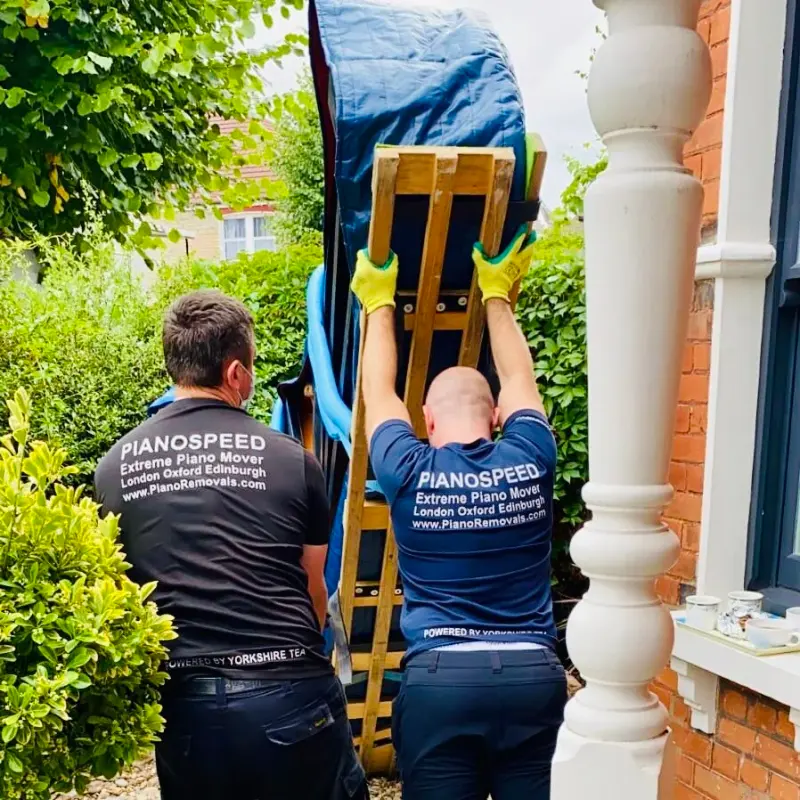
The physical process follows the same method as any specialist move. Upright pianos travel in triple-thickness fitted transit covers on a padded skid board. Grand pianos have the legs and pedal lyre removed individually and wrapped, with each component packed into its own padded bag; the body travels on its straight side in a heavy-duty crate. Saleroom floors are often polished stone or hardwood, and the crew uses soft-wheeled dollies throughout to avoid any floor contact with the instrument or its hardware.
Stairs are chargeable at both ends. Many auction houses have service lifts or loading ramps for intake, but some do not, and the loading bay level does not always match the display floor. The access at the auction house is priced into the quote when you describe it, the same way any delivery address is.
Delivery to the buyer after the sale
Once a piano sells, it needs to move again. The buyer may be local or may be in Edinburgh, Belfast or Cornwall. Auction houses typically give buyers a collection window of one or two weeks; if the buyer cannot collect in person, they arrange a carrier. PianoSpeed operates nationally, covering every London postcode, Surrey and the GB mainland, with a dedicated Belfast to England lane, so it can handle the outbound leg as well as the intake delivery.
Some sellers arrange the collection-to-auction leg and leave the saleroom to coordinate the buyer delivery. Others prefer to use the same specialist for both stages and ask us to handle the transit once the hammer falls. Either approach works. The buyer or the auction house can get a fixed price at book.pianospeed.com.
Antique and high-value instruments
Older auction-bound pianos sometimes need a higher degree of care. A Broadwood square piano, an ornate Victorian boudoir grand or a pre-war Bechstein in original condition has casework and hardware that requires more careful wrapping and positioning. The same core methods apply, with additional attention to decorative marquetry, inlaid panels or original fittings. A specialist mover with experience of antique and heirloom instruments will flag any handling considerations before collection and, if the saleroom needs to know, confirm the plan with the intake team in advance.
The guide to moving antique and heirloom pianos covers those considerations in more detail and is worth reading before the collection is booked.
Common questions
Do auction houses have a standard intake window?
There is no single standard. The major London salerooms typically have set intake days and require a pre-booked slot through their porters' department. Regional salerooms vary. Confirm the delivery window directly with the auction house before arranging transport, then pass those details to the mover when you place the booking.
Who arranges the move, the seller or the auction house?
In most cases the seller arranges the collection and delivery to the saleroom. The auction house does not typically provide transport, though some can suggest carriers they have worked with. The contract for the move is between the seller and the transport provider. PianoSpeed is fully insured for transit and provides condition documentation as standard.
What documentation does PianoSpeed provide?
Condition photographs are taken before wrapping and again at delivery, with notes of any pre-existing marks on the transit record. These are available to the seller on request. For high-value instruments, a more detailed written condition record can be agreed in advance.
Can PianoSpeed deliver to the winning bidder after the sale?
Yes. Once the sale is complete and the buyer has confirmed an address, PianoSpeed can collect from the saleroom and deliver anywhere in Great Britain or Northern Ireland. Get a fixed price at book.pianospeed.com.
How much does it cost to move a piano to an auction house?
Piano moves start from £125. The price is calculated from the collection address, the access at each end and the delivery address. Stairs are chargeable at both ends. Get an instant fixed price at book.pianospeed.com.
Book a specialist auction delivery
To arrange a specialist collection for an auction-bound piano, or to handle delivery to a buyer after the sale, get an instant fixed price at book.pianospeed.com or call PianoSpeed London Limited on 020 7164 0000. The office is at 71-75 Shelton Street, Covent Garden, London WC2H 9JQ. Rated 4.9 out of 5 on Trustpilot from 77 reviews.
Book your move in 2 minutes
When it has to arrive perfectly, there is no second choice.
Get an instant quote★★★★★ Rated 4.9 out of 5 on Trustpilot from 77 reviews