
Blog · 26 June 2026
Why use specialist piano movers instead of a general removals firm
The direct answer is equipment, crew training and insurance. A general removals firm may agree to move a piano, but it is unlikely to carry the specialist kit that protects the instrument in transit, a crew that understands how piano weight shifts when tilted, or an insurance policy written around high-value musical instruments. If those three things are missing and something goes wrong, the consequences fall on you. PianoSpeed's specialist piano movers cover London, Greater London, Surrey and GB mainland, with a Belfast to England lane, and bring all three to every job. You can get an instant fixed price at book.pianospeed.com and compare before you decide who to book.
What a general removals firm brings to a piano job
Most general removals firms are skilled at moving furniture and boxes. A piano is neither. It is heavy, unevenly balanced, has a finish that marks from bare contact, an action that can be disturbed by impact, and no natural handholds. When a general firm takes on a piano job they typically have furniture blankets and straps, but not fitted transit covers designed for piano cases, not a padded skid board, and not a purpose-built piano dolly with the capacity to hold a quarter of a tonne safely. Some firms take the job without disclosing these gaps; others decline outright, which is the more transparent position.
There is also the crew question. Moving a wardrobe requires strength and grip. Moving a piano requires knowing how its centre of gravity shifts as the instrument tilts, which angle is safe for the action, and how the access route geometry determines which face the piano should travel on. A crew that encounters a piano once a month handles it differently from one that moves pianos on every shift.
The equipment a specialist carries
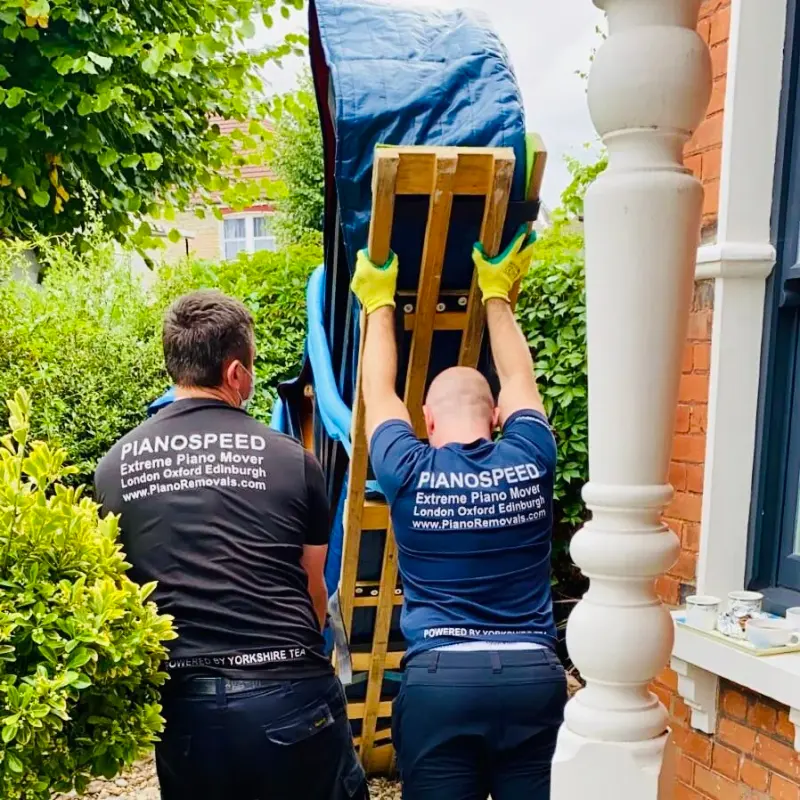
The most visible difference between a specialist and a general remover is the protection on the instrument before it leaves the room. At PianoSpeed we use top-of-range triple-thickness fitted transit covers tailored specifically to each piano, not loose furniture blankets that shift under load. A fitted cover stays in place around corners and on stairs, guarding the case, the keys and the polish from the moment the instrument moves.
- Triple-thickness fitted transit covers that do not slip under load
- A padded piano skid board for every section of the move beyond a few metres
- Purpose-built piano dollies with sufficient capacity for grand pianos
- Individual padded bags for each grand leg and the pedal lyre
- A heavy-duty crate for the grand body when access requires it
On a grand piano, the legs and pedal assembly are the most vulnerable parts and the most costly to repair if damaged. We remove them before the piano leaves the room, pack each leg in its own padded bag, and stow everything in a heavy-duty crate. The body travels on its flat side on a purpose-built padded board, not on its own castors. A general removals firm is unlikely to carry any of this equipment.
Crew training and what it changes
A piano-trained crew is not simply a strong one. They understand which face of the instrument should face up at each stage of the move, where the weight concentrates and what happens when the piano tilts past a certain point. They read a staircase and plan the angle of approach before anything moves. They know when to stop and reassess rather than force the job, and they know which panels to remove to make a narrow Victorian doorway work.
Staff at PianoSpeed move pianos on every working shift. That repetition builds a specific kind of judgement that a generalist, however careful, does not accumulate from occasional piano jobs. The instrument and the access route are understood before the move starts, not discovered during it.
Insurance, and what it actually covers
Most general removals firms carry goods-in-transit insurance, but those policies vary considerably. High-value items, including musical instruments, often sit in a category that requires separate declaration or that carries a per-item limit well below the instrument's value. It is worth asking a general firm exactly what their policy covers for a piano and reading it before you book rather than after something has gone wrong.
A specialist piano mover carries insurance written around the specific risks of piano moving. Ask any mover you are considering to confirm in writing what their policy covers for your instrument and what the claim process involves. A specific, clear answer is what you want. A vague one is also useful information.
Why access is where most damage happens
Almost all piano damage occurs at doorways, staircases and tight turns rather than on the road. The transit section of a piano move is the lowest-risk part. Getting the instrument from where it stands to the vehicle, and from the vehicle into its new location, is where the equipment, the crew judgement and the route planning all come together. A specialist assesses the access from the information you provide when booking, and arrives prepared for it.
Stairs at either address are chargeable. The instant online quote at book.pianospeed.com asks for the access details at both addresses, including floor levels and lift availability, and prices the whole job automatically. The figure you see is a fixed price for the real access at both ends, not an estimate that changes when the crew arrives.
Questions worth asking before you book
Does a general removals firm cost less for a piano move?
The initial quote may be lower. But a general firm may not be pricing the full job: if they do not carry specialist transit protection, a piano-trained crew or adequate insurance, the lower quote reflects a lower quality of service. The cost of repairing a damaged piano case, replacing a snapped grand leg or pursuing a claim against a policy with gaps can be substantially more than the difference between the two quotes.
What happens if a general removals firm damages the piano?
The claims process matters as much as the policy limit. A general firm may dispute whether damage occurred during the move or was pre-existing. A specialist will have photographed and assessed the instrument before it moved, giving both parties a clear starting point. Ask any mover how they document the condition of the piano before the job starts.
How does a specialist quote for stairs and access?
The online quote at book.pianospeed.com asks for the number of floors at both the collection and delivery addresses and whether a lift is available. The system calculates the access charge based on those details, so the price you see covers the actual job. Stairs are priced during the booking, not added as a surprise once the crew arrives.
Is it worth using a specialist for a short local move?
Yes, because the risk is the same regardless of distance. Damage to a piano happens during the access, not because the journey was long. A 200-metre studio move with a narrow staircase carries the same access risk as a move across the country. The specialist equipment and crew training are for the access, not the mileage.
How do I know a piano mover is genuinely specialist?
Ask what transit covers they use, whether they use a padded skid board, and how grand legs and pedals are handled separately. A genuine specialist will give specific, concrete answers to all three. PianoSpeed is rated 4.9 out of 5 on Trustpilot from 77 reviews, all from real piano moves. Every move is fully insured.
Book a specialist piano mover
Piano moves start from £125. For a fixed price that covers your specific instrument, the access at both addresses and a confirmed delivery date, get an instant quote at book.pianospeed.com. Answer a few questions about the piano and both locations and you will see a fixed price with available dates. Book in two minutes online, or call 020 7164 0000 if you want to talk through an unusual access situation first.
Book your move in 2 minutes
When it has to arrive perfectly, there is no second choice.
Get an instant quote★★★★★ Rated 4.9 out of 5 on Trustpilot from 77 reviews