
Blog · 10 September 2026
Moving a piano in a period house with narrow doors and low ceilings
Moving a piano in a period house is almost always harder than moving one in a modern property, even when the rooms are spacious. The problem is not usually the room the piano lives in: Victorian reception rooms can be generous. The problem is the route from that room to the front door, and everything in between. Narrow hallways, steep staircases with tight landings, low ceiling runs, and doorways narrower than current building standards all require specialist planning and sometimes specialist kit that a general removals crew will not carry. If you are moving a piano in or out of a Victorian terrace, an Edwardian semi or a Georgian townhouse, this is what the crew will actually face.
Why period houses present specific access challenges
Most UK period houses were built before the piano became a standard piece of drawing room furniture. The grand pianos of the 18th and early 19th centuries were instruments for great houses with wide doors and high-ceilinged galleries. The Victorian terraces built for the middle and working classes from the 1850s onwards were not designed with piano access in mind, and by the time the upright piano had become commonplace in suburban homes, the housing stock was already fixed.
A standard Victorian terrace typically has a hallway width of around 900 to 1,000 millimetres, compared with modern guidance of around 1,050 millimetres. The internal doors are often narrower than the front door, sometimes as little as 650 or 680 millimetres, while a standard upright piano is around 550 millimetres deep and 1,380 to 1,530 millimetres wide. Getting that through a 680mm door in a straight line is impossible. Getting it through at an angle, with a heavy cast-iron plate and a soundboard that cannot take impact, requires a clear plan before the crew arrives.
The Victorian terrace: the hallway problem
The classic London Victorian terrace has a reception room at the front, a second reception or dining room behind it, a small lobby or corridor, and a kitchen extension at the rear. Pianos usually sit in the front room. The route out is either through the front door, down one or two front steps, and into the street, or through the entire length of the house and out via the garden. Most moves go through the front door.
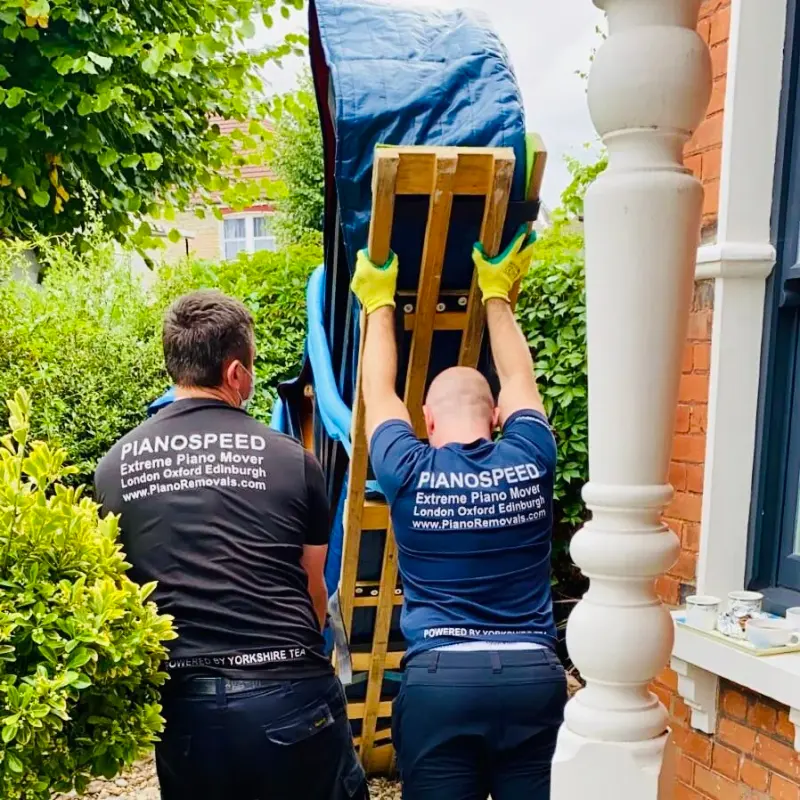
The hallway in a mid-terrace is too narrow to turn an upright piano from the front room door to the front door in one movement. The crew will typically tilt the piano on the skid board to bring it out of the room door at an angle, then straighten it to travel down the hall. Low ceiling coving, picture rails and dado rails are all at risk if the tilt is not controlled, so the crew checks overhead clearance first. Front door thresholds and front steps are measured, not assumed.
Edwardian and inter-war houses: wider but not easy
Edwardian houses, built from roughly 1901 to 1918, tend to be a little more generous than their Victorian predecessors: halls are often wider, ceilings slightly higher in the passages. But Edwardian semis frequently have a dog-leg staircase rather than a straight flight, and the half-landing can be very tight. The piano has to negotiate the first flight, stop on the landing, be repositioned, and then move again on the upper flight, all at a steep angle with limited space to hold the instrument between movements.
Inter-war houses, from the 1920s and 1930s, were often built with wider standard doors and more regular proportions. They are usually easier, but the same basic rule applies: measure the actual doorways, not the ones on the floor plan.
Georgian townhouses and mansion blocks
Georgian townhouses present a different set of problems. The rooms are often tall and wide, which helps. But Georgian staircases can be very steep and very narrow relative to the floor area, and the front door steps and the pavement outside are frequently not wide enough to turn a grand piano. Basement flats in converted Georgian terraces often have a separate entrance below street level, with steps that are too steep for a stair-climbing trolley and too narrow for a full crew.
Mansion blocks, typically built from the 1880s to the 1930s, usually have a lift, which solves one part of the problem. But the lift internal dimensions often make the difference between possible and impossible for a grand piano, and the angle from the lift to the flat door can be too tight to work with even a smaller instrument. A crew that moves pianos into mansion blocks regularly will know this and will measure the lift before booking the move.
What the specialist crew does differently in a period property
A specialist piano moving crew arriving at a period property will do several things that a general removals team will not. The first is a proper route check. Every doorway on the route is measured, not estimated. Any section of ceiling that is low enough to interfere with a tilted upright is noted. The staircase geometry is looked at carefully: the pitch, the landing dimensions and any turn in the flight all affect which technique the crew uses.
- Doorways measured and checked against the piano dimensions before moving starts
- The piano prepared for the specific route: lid removed, lower panel taken off, music desk stored safely
- Padded transit cover fitted before the instrument moves from its room
- Piano moved on a padded skid board, not on its own castors, for any distance beyond a few feet
- Stair-climbing equipment or manual crew positioning chosen to match the specific staircase
- Period floors and carpets protected before the skid board is moved across them
On a very tight doorway, there are three options. The piano can be tilted at a steeper angle than usual, bringing its width profile down. The door itself can sometimes be removed from its hinges, gaining the extra 40 to 60 millimetres that a door leaf occupies. Or partial disassembly of the piano can help: on most uprights, the lower panel below the keys lifts out, and on some instruments the lid and the top trim come away without tools. None of this is drastic, and a crew that does this regularly will know which option suits which instrument.
Crane lifts and sash window access
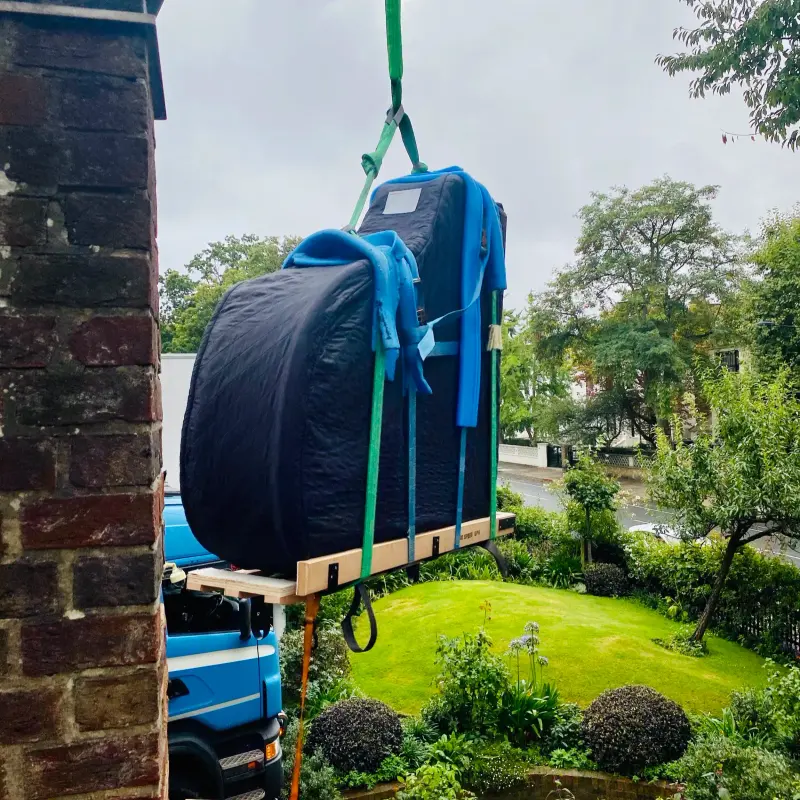
Where an internal route is genuinely impossible, the alternative is external access. In London, this usually means a crane lift from the street into the property through a window opening. Sash windows in Victorian and Georgian houses open to a height that is often enough for an upright piano to pass through at a tilt, and the piano can be rigged from a lorry-mounted crane on the street.
A crane lift requires a crane and lorry with street access, which means a parking suspension on the public road. The crew organises this, but it needs to be booked well in advance, sometimes two to three weeks ahead, depending on the local authority. The cost is higher than a standard move because of the equipment and logistics involved. That cost is calculated in your online quote when you describe the access route accurately. Crane lifts are unusual but not rare in central London, particularly for basements and upper floors in Georgian and early Victorian properties.
Protecting period interiors
A period house often has features that are harder to repair than a modern one. Cornicing, picture rails, dado rails, original tiled hallway floors, and narrow skirtings are all at risk from a piano move that is not managed carefully. The crew uses protective sheeting on the floor before the skid board is set down, and door frames are padded where the piano will pass close to them. The fitted transit cover protects the piano from the house; the sheeting and padding protect the house from the piano.
Original parquet floors and Victorian encaustic tile paths are worth flagging when you book. The skid board distributes the piano weight rather than concentrating it, which helps, but the crew should know in advance rather than discover a fragile original floor on the day.
Common questions about period house piano moves
My Victorian front door is only 720mm wide. Is that wide enough?
Probably, depending on the piano. A standard upright is around 550mm deep and the skid board adds a little to that, but the total through-the-door width at 90 degrees can be brought down by tilting the instrument. A 720mm clear opening is workable for most uprights but tight for any grand. Give the door dimensions when you book and the crew will confirm before the day.
Does the doorway width include the door or is it the clear opening?
Give the clear opening: the measurement from jamb to jamb with the door open. The door leaf takes up 40 to 60mm in a standard UK frame, so a door that is nominally 760mm will often give you around 700 to 720mm of clear width. Measure the narrowest point, which is sometimes the frame itself rather than the gap at full open.
My staircase has a low beam at the top. Can you still get the piano up?
Possibly, depending on how low it is and what the piano dimensions are. A beam that sits at 1.8 metres above the stair will be fine for most uprights on their side. A beam at 1.5 metres may require a different approach or may rule out an upright going upstairs entirely. Measure the lowest point and give that figure when you book. The crew will tell you what is possible and whether a crane lift from outside is the better option.
Will the crew need to remove doors from their hinges?
Sometimes, yes. Removing a door from its hinges typically gains around 40 to 60 millimetres of clear width, and it takes about two minutes with the right tools. It does not damage the door or the frame if done properly. On a tight doorway in a period house it is often the simplest solution. A specialist crew carries the tools for this as standard.
Are stairs chargeable on a period house move?
Yes. Stair access is always chargeable, and access including floors, steps and whether a lift is available is calculated automatically in the instant online quote at book.pianospeed.com. The price you see includes the specific access at both ends of the move. There are no surprises on the day.
How far ahead do I need to book for a period house piano move?
For a straightforward move in a period house, the usual lead time applies: a few days to a couple of weeks depending on your location and the delivery day schedule for that postcode. If a crane lift is needed, allow at least two to three weeks to organise the parking suspension. It is always worth calling 020 7164 0000 to discuss access specifics before booking online if you are uncertain.
Get a fixed price for your period house piano move
Piano moves start from £125. For a fixed price covering your specific piano, both addresses and the actual access at each end, get an instant online quote at book.pianospeed.com. The system asks the questions that affect the price: the type and size of piano, the number of steps, whether a lift is available, and the delivery postcode. It calculates everything automatically and shows you a fixed price with available dates. You can book in two minutes, or call 020 7164 0000 to talk through any access questions first. PianoSpeed is rated 4.9 out of 5 on Trustpilot from 77 reviews.
Book your move in 2 minutes
When it has to arrive perfectly, there is no second choice.
Get an instant quote★★★★★ Rated 4.9 out of 5 on Trustpilot from 77 reviews