
Blog · 13 September 2026
What happens on piano moving day: a walkthrough for owners
On piano moving day the crew follows the same sequence on every job: arrive, survey the access, wrap and protect the instrument, carry it out, load it, drive to the delivery address, carry it in, position it in the room and run a final check. Most owners are surprised by how methodical and quiet the process is. The crew does not rush; rushing is how pianos get damaged. For a fixed price with access and stairs included before the day starts, get an instant quote at book.pianospeed.com.
The crew arrives and walks the route
The crew arrives within the agreed window and introduces themselves before starting. The first thing they do is walk the route from the room where the piano is standing to the street. This takes a few minutes. They are checking door widths, stair geometry, floor surfaces, ceiling heights on stair turns and the parking and loading position outside. They ask about any access detail that differs from what was described at booking: a lift that has gone out of service, a corridor that is now partly blocked, a door that sticks. If a doorway is tight, removing the door from its hinges is often the first action, before any piano has been touched.
If you have concerns about the route, raise them when the crew arrives rather than waiting until the piano is already in motion. The earlier in the job a question comes up, the more options there are for handling it.
Protecting the piano before it moves
Once the route is confirmed, the crew prepares the piano before moving it a centimetre. For an upright, this means fitting a top-of-range, triple-thickness fitted transit cover tailored to the instrument. The lid is checked to confirm it is closed and, where there is a lock, locked shut. The padded skid board is positioned beneath the piano so it can be moved without the castors touching a surface where grip is uncertain.
For a grand piano, the sequence takes longer. The crew removes the piano legs one at a time, lowering the body down onto a padded grand board as each leg comes off. Each leg, along with the pedal lyre, goes into individual padded bags inside a heavy-duty crate. The top lid is secured, the entire body is wrapped in fitted transit covers, and the instrument rests horizontally on the grand board for the carry. Owners who have not seen this before sometimes find it alarming; it is the correct method and is how concert grands are moved worldwide.
Carrying the piano out
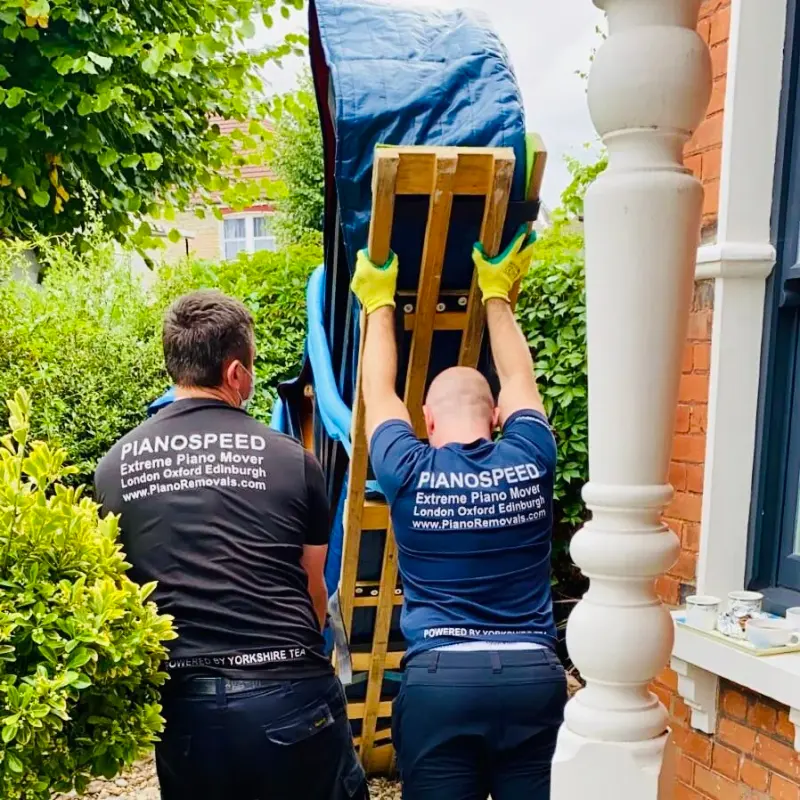
With the piano prepared, the crew carries it from its room to the vehicle. On an upright this usually involves tilting the instrument backward onto the skid board and moving it on that platform through corridors and to the top of any staircase. On a staircase, the crew walks the piano down step by step under controlled load, with one person guiding from each end. The pace is slow and deliberate.
On a grand, the body on its grand board is carried horizontally through the property. A grand is lower and longer than an upright, which creates different challenges at doorways and stair turns, but the wrapped body on a padded board gives the crew a controlled, stable carry. Stairs at either address are chargeable and are priced automatically in the instant quote at book.pianospeed.com when you enter the floor level at each end.
During the carry, keep the route clear and keep children and pets out of the staircase and loading area. The crew is managing a heavy instrument in a tight space and cannot stop safely at short notice if something appears in the path.
Loading and securing the piano in the vehicle
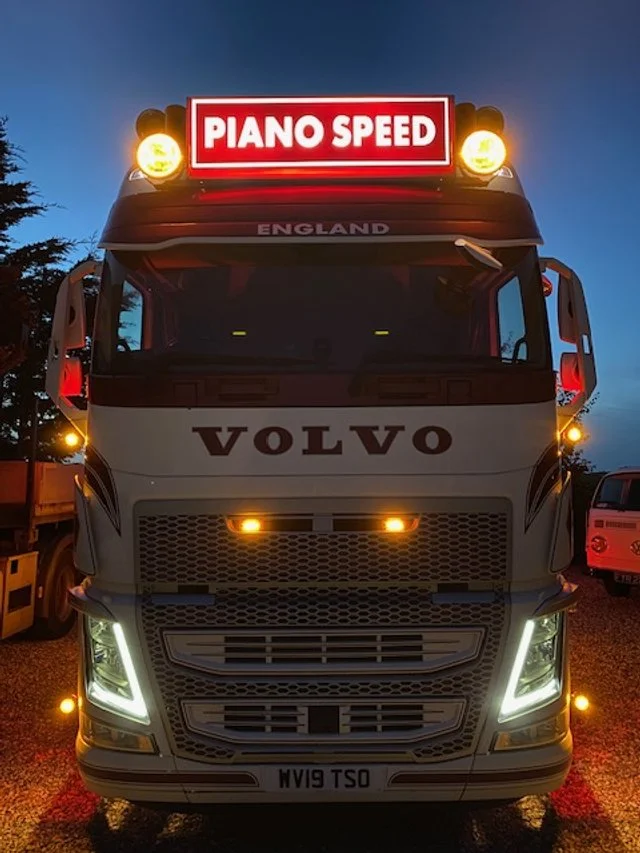
The vehicle has a dedicated load area equipped for piano transport. The piano is loaded via a tailgate lift or ramp and secured within the vehicle using straps and load restraints. An upright travels strapped upright against the side of the vehicle. A grand travels on its grand board in the load area. Nothing else is stacked against the piano.
Loading takes around ten to twenty minutes depending on the size of the instrument and the distance from the front door to the vehicle. Once the piano is secured, the crew does a brief check before setting off.
In transit
The drive to the delivery address is straightforward for most London, Surrey and GB mainland jobs. The crew plans the route in advance and knows the size restrictions on the delivery road from the access details given at booking. If you are the owner and you are travelling to the delivery address separately, there is no need to try to follow the vehicle. The crew calls when they are on their way, or when they arrive, depending on what was arranged when you booked.
Long-distance moves to addresses on the GB mainland, including Scotland, the North of England, the Midlands, Wales and Belfast, follow the same loading and securing procedure. The difference is route time, not method.
Carrying the piano into the delivery address
Arrival at the delivery address begins the same way as collection: the crew walks the route from the street into the room before the piano comes off the vehicle. Surprises at this stage are uncommon when accurate access details were given at booking, but the crew checks rather than assumes.
The piano comes off the vehicle and is carried in using the same method as collection, reversed. For a grand, the body goes in first on the grand board, and the legs are reattached once the instrument is in the room. Leg reattachment on a grand is done carefully: the crew checks each leg is seated and secure before moving on to the next one. Once all three legs are back on, the piano is lowered off the grand board onto its own feet and the board is removed.
Positioning and final checks
With the piano in the room, the crew positions it where you want it. Tell them before they start carrying, not once the piano is already in the room, because repositioning a fully wrapped grand after the fact is extra work. If you are unsure about the final position, use furniture to mark where you want the piano to stand before the crew arrives.
Once the piano is in position and the transit covers are removed, the crew does a brief final check: the instrument is level, the castors or feet are settled, the legs on a grand are confirmed secure, the lid opens cleanly. For a grand, the pedal lyre is re-fitted last. The crew then asks you to confirm the condition of the instrument before signing off the job.
A job with straightforward access at both ends takes around two to four hours from collection to delivery, including transit. A move involving multiple flights of stairs, a narrow Victorian terrace, or a long-distance route will take longer, and the booking team will have given you a realistic time estimate when you confirmed the job.
Piano moving day: common questions
What time will the crew arrive?
The booking confirmation includes a time window. For London and Surrey jobs the crew works a planned route and the arrival time is the start of that window. Call 020 7164 0000 on the morning if you need a more precise arrival estimate.
How long does the whole job take?
A standard upright piano move with level or single-flight access at both ends takes around two to four hours from the crew arriving at collection to the piano being in position at delivery. Longer access, multiple flights or a long-distance route extends this. The booking team will have given you a time estimate when the job was confirmed.
Do I need to be present throughout?
Yes, or have a responsible adult present at each address. Someone needs to be available to confirm the route, agree the piano's position in the delivery room and sign off the job at the end. If collection and delivery are at different addresses and happening the same day, arrange a trusted person at each location.
Will the crew play the piano or test it after delivery?
No. The crew's job is to move the instrument, not to assess its mechanical condition. If the piano needs attention after a move, the standard advice is to allow it to settle in its new location for a few weeks and then have it tuned by a registered tuner.
What happens if the piano does not fit through a doorway?
The crew will have planned the access from the details given at booking. If a doorway is tight, removing the door from its hinges is usually the first step. A specialist crew will not attempt to force a piano through an access it cannot safely pass through. If the piano genuinely cannot enter the room as described, the crew will tell you what the options are and contact the office to discuss the situation.
Are stairs included in the price?
Stairs are chargeable at both addresses. The instant quote at book.pianospeed.com asks for the floor level at each end and prices stair access automatically. The figure shown is fixed, not an estimate that changes when the crew sees the staircase.
Can the crew store the piano temporarily if the delivery address is not ready?
Short-term hold situations are handled on a case-by-case basis. Speak to the team at 020 7164 0000 if the delivery address will not be ready on the planned collection day. Attempting to store a piano in a self-storage unit or a standard removal vehicle overnight is not recommended: piano storage requires controlled conditions that standard storage facilities do not provide.
Book a specialist piano move
Piano moves start from £125. Get a fixed price for the piano, the access at both addresses and a confirmed date at book.pianospeed.com. The quote takes two minutes. For anything more complex, call 020 7164 0000. PianoSpeed is rated 4.9 out of 5 on Trustpilot from 77 reviews. PianoSpeed London Limited, 020 7164 0000, 71-75 Shelton Street, Covent Garden, London WC2H 9JQ. Part of the Pianospeed Group.
Book your move in 2 minutes
When it has to arrive perfectly, there is no second choice.
Get an instant quote★★★★★ Rated 4.9 out of 5 on Trustpilot from 77 reviews