
Blog · 21 September 2026
Moving a Kawai piano: what the specialist does differently
Kawai builds a wider range of instruments than most owners expect to discuss when they first contact a piano mover. There are the K-series uprights from studio heights to the tall K-900, the GL-series grands from 153 cm up to the full Shigeru Kawai concert grands at 275 cm, and the Novus hybrid range with its real piano key mechanisms. Each type has handling considerations a general removals firm will not account for. For a fixed price on moving your Kawai, go to book.pianospeed.com and enter the model and access details. The quote is instant and the price is fixed before you confirm.
If you are unsure of the exact model, the most useful thing to give the booking team is the type (upright, baby grand or grand), the approximate height or length, and the finish. That is usually enough to plan the crew size and method.
The composite action: what it means in practice
Kawai's most distinctive technical feature is the Millennium III action, the key moving parts of which are made from a carbon composite material rather than wood. The argument for this is dimensional stability: wood expands and contracts with changes in humidity, and composite parts are less affected. A Kawai action adjusts to a new room more quickly after a move than a wooden-action piano of similar quality. Piano technicians generally find a Kawai ready for a reliable tuning appointment sooner than a comparable instrument built entirely from wood.
This does not mean the instrument tolerates rough handling. The action is precisely regulated and the escapement, repetition and let-off settings are as sensitive to vibration or a sudden impact as those of any quality piano. The method is the same: the instrument is secured and padded before it moves, and nothing is rushed.
The Shigeru Kawai range
At the top of the Kawai grand range sits the Shigeru Kawai line, named after the company's founder and built to concert standards. The range runs from the SK-2 at 180 cm to the SK-7 at 275 cm. These are premium instruments built to tolerances and a case finish comparable to a Steinway or Bechstein, and they are handled accordingly.
If you are moving a Shigeru Kawai, tell the booking team the model and the finish. High-polish case finishes show marks left by a transit cover that creases or bunches against the surface. Specialist piano transit covers are thick, fitted and checked to lie flat before the instrument is moved. PianoSpeed uses triple-thickness fitted transit covers on all grands. The cover goes on last and is inspected before the piano is secured in the vehicle.
Kawai Novus hybrid instruments
The Kawai Novus range sits between acoustic and digital. The NV-5S, NV-10S and earlier Novus models have real wooden keys and an acoustic hammer mechanism, but the sound is generated digitally. This makes them heavier than a conventional digital piano and gives them real piano mechanisms that can be damaged by rough handling.
A Novus instrument should be booked and moved as a piano, not as electronics equipment. The action is regulated just as it is in an acoustic Kawai upright, and the same category of handling damage applies if the instrument is tilted roughly or set down without care. When you book, tell the team it is a Novus hybrid so they come with the right method and equipment.
The Kawai grand range: what to say when booking
Kawai's GL-series grands run from the GL10 at 153 cm to the GL50 at 180 cm, with weights from around 240 kilograms to around 330 kilograms. The Shigeru Kawai range extends the size and weight upwards. The weight differences across the range matter for crew planning, particularly when stairs are involved.
- Model name if known: GL-10, GL-30, SK-3 and so on.
- Length from the straight side of the case to the curved tail end, if the model name is not available.
- The finish: polished ebony, satin black, white polyester or any other colour.
- Access at the collection address: stairs, lift dimensions, doorway widths, ceiling height at the top of any staircase.
- Access at the delivery address: the same information, plus the orientation of the room where the piano will stand.
At the collection address the crew works in the same sequence as for any grand. The lid is closed and the fallboard is secured over the keys. The music desk is lifted out and wrapped separately: it is easily damaged if left in place during a move. The two side legs come off before the single keyboard-end leg, because removing the keyboard-end leg first causes the body to tip forward without warning. The pedal lyre is unbolted with its connecting rods supported throughout.
With the legs and lyre removed, the body goes onto a padded grand skid board and travels on its straight side, bass end down, keyboard end up. The transit cover is placed and checked to lie flat. At the destination the crew checks the full route before anything comes off the vehicle.
K-series uprights: weight and stair access
Kawai's K-series uprights run from the K-15 studio model at 109 cm to the K-900 at 133 cm. The K-800 and K-900 carry large cast-iron frames and are significantly heavier than smaller uprights. A K-900 approaches the weight of a small baby grand, and it is worth naming the model when you book so the crew is sized for the actual weight rather than an estimate.
Kawai uprights move on a padded upright dolly, keyboard side padded away from any contact surface. Stairs are chargeable for all uprights, and the stair charge is calculated automatically at book.pianospeed.com when you enter the access details. The information the booking team needs is the number of steps, the staircase width, whether there is a half-landing, and the ceiling height at the top of the flight.
Stairs and crane access for Kawai grands
A Kawai grand on stairs needs clearance at every point on the route: the width of the staircase to accommodate the skid board, headroom as the instrument is tilted through any half-landing, and doorway clearance from frame to frame. Many London period properties have staircase widths that work but ceiling heights or half-landing turns that need to be confirmed before the day.
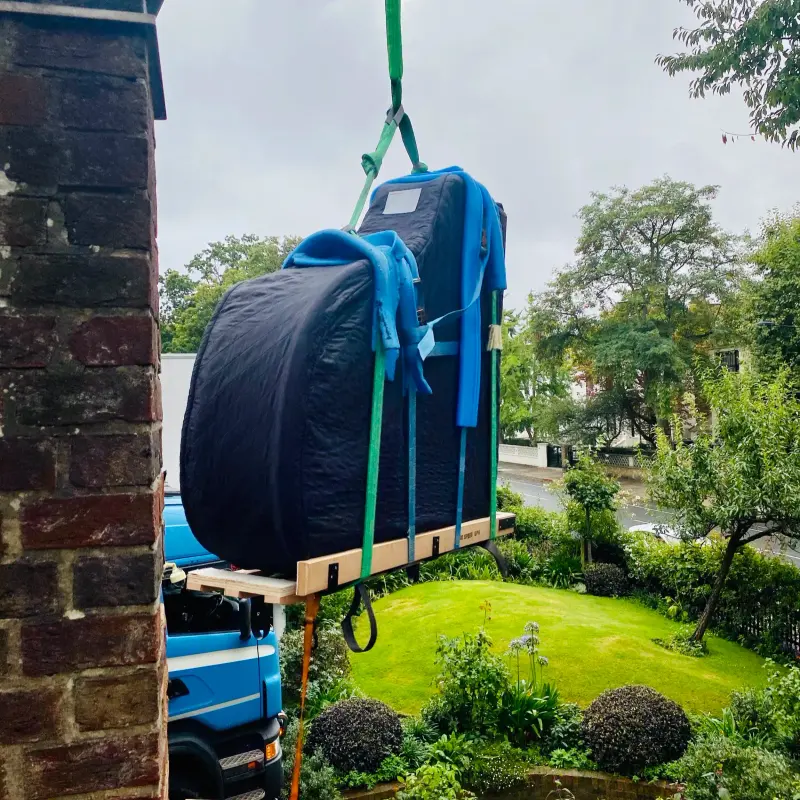
Where a staircase move is not workable, the alternative is a crane lift. The piano is rigged and raised externally through a window or over a balcony. The price is agreed and fixed before the day once the access has been assessed. If your access at either end is unusual, describe it as accurately as you can when you book.
After the move: settling and tuning
Because the Millennium III composite action is dimensionally stable, a Kawai often settles into a new room faster than a wooden-action instrument. The standard two to four week waiting period before tuning still applies, but Kawai owners and piano technicians sometimes find the instrument is stable enough for a reliable tuning appointment at the shorter end of that range.
For a Shigeru Kawai, allow the full period. These instruments are built to concert tolerances, and the soundboard, bridges and pin block still need time to equilibrate to the temperature and humidity of the new space. Tell your tuner the instrument has recently moved so they can assess the action alongside the pitch.
Frequently asked questions
Does the composite action change how the piano needs to be moved?
Not the method itself. The composite Millennium III parts are more dimensionally stable across humidity changes, but the action is precisely regulated and the same care applies during the move. The benefit shows up after the move, in a faster settling period and a more predictable tuning appointment.
Should a Kawai Novus hybrid be moved as a piano or as electronics?
As a piano. The Novus range has real acoustic key and hammer mechanisms that can be damaged by rough handling. Book it and move it as an upright piano, and tell the booking team it is a Novus hybrid.
Is a Kawai K-800 heavier than it looks?
Yes, considerably. The K-800 and K-900 have large cast-iron frames and sit in the weight range of a small baby grand. Name the model when you book so the crew is the right size for the actual weight.
Can a Kawai GL-30 go up a London staircase?
Many London staircases can take a GL-30, but the staircase width, any half-landing turn and the ceiling height at the top of the flight all need to be assessed. Enter the access details accurately at book.pianospeed.com and the booking team will confirm the method. Where the staircase is not suitable, a crane lift is the alternative and the price is fixed before the day.
How soon can I tune my Kawai after the move?
Two to four weeks is the standard recommendation, though Kawai's composite action often means the instrument is ready at the shorter end of that range. Check with your piano technician after a couple of weeks and let them know the piano has recently moved.
For a fixed price on moving your Kawai, go to book.pianospeed.com and describe the model, the type and the access at both ends. Piano moves start from £125. You can also call 020 7164 0000. PianoSpeed is rated 4.9 out of 5 on Trustpilot from 77 reviews, all from real piano moves across London, Surrey and the UK. PianoSpeed London Limited, 71-75 Shelton Street, Covent Garden, London WC2H 9JQ.
Book your move in 2 minutes
When it has to arrive perfectly, there is no second choice.
Get an instant quote★★★★★ Rated 4.9 out of 5 on Trustpilot from 77 reviews