
Blog · 8 August 2026
Moving a Bechstein piano: what the specialist does differently
Moving a Bechstein is not just a matter of adding more crew. The instrument has been built to tight tolerances since the Berlin workshops opened in 1853, and the case finish on a high-polish Bechstein grand is unforgiving of anything placed against it without proper padding. A specialist crew handles a Bechstein with a higher level of precision at every stage, from the sequence in which the legs come off to the way the transit covers sit against the case in the van. This article sets out what that looks like in practice.
For an immediate fixed price on moving your Bechstein, go to book.pianospeed.com. If you want to talk through the access or the specific model before booking, call 020 7164 0000.
What makes a Bechstein different to move
Bechstein produces a relatively small number of instruments each year compared with volume manufacturers. The grand range runs from the baby A 188 and L 167 up to the full concert D 282, and the upright range from the Compact 116 to the Concert 131. What they share is a case finish and an action quality that are less forgiving of a rough approach than a production instrument.
The case finish is the first thing a crew needs to account for. High-polish ebony is the most common finish on a Bechstein grand, but walnut and mahogany models exist, and satin finishes are available across the range. A transit cover that bunches against a high-polish surface, or a strap without adequate buffering, can leave a mark that is visible and disappointing on delivery. Crews who regularly move premium instruments check the condition of their covers before placing them against a polished case.
The action is the second consideration. Bechstein grands are individually regulated before they leave the factory, and the regulation, the precise adjustment of each key's weight, depth and return, is set to tight tolerances. Rough handling that shifts action components or vibration that works loose regulation screws can alter the feel of the keyboard in ways a Bechstein-trained technician would need to address. That is an avoidable problem when the crew knows what they are doing.
Preparing a Bechstein grand for the move
At the collection point, the crew follows a deliberate sequence. The lid is closed and the fallboard is secured over the keys. The music desk is lifted out and wrapped separately. These small parts are easy to damage in transit and are best kept away from the main body.
The legs are then removed in a specific order. The two side legs come off first. The single leg at the keyboard end is removed last, because the body needs both side legs as support before that leg can safely come away. Removing the keyboard-end leg too early causes the body to tip forward without warning. The pedal lyre is unbolted with care: the connecting rods that run from the pedals up into the action mechanism are fragile at the attachment points, and lateral stress on them during removal risks bending or cracking a rod.
With the legs and lyre off, the body goes onto a padded skid board purpose-built for grand pianos. The piano travels on its straight side, bass end down, keyboard end up. The case is then wrapped in a heavy-duty transit cover. For a high-polish Bechstein, the cover needs to lie flat without any folds or bunching against the case, because even a minor crease held against a polished surface through a two-hour drive can leave a mark. Legs and lyre each go into padded bags and are secured in the van separately from the body.
Bechstein uprights: different in weight and method
Bechstein uprights are heavier than their external dimensions suggest. The Concert 131 in particular carries a large cast-iron frame and a weight that makes it comparable to a small baby grand. When you book, telling the team which model you have helps considerably. Even an approximate model name lets the booking team calculate the crew size accurately and plan the method for any stairs.
An upright travels on a padded upright dolly. The keyboard side is padded away from any contact surface throughout the move. At the destination, the crew checks the route before the piano comes off the vehicle and ensures there is clear floor space for the dolly at every point on the route to the final position.
Stairs are chargeable for a Bechstein upright, as they are for any piano. The charge reflects the crew size and the time required. When you enter the access details at book.pianospeed.com the stair charge is calculated automatically. The information the booking team needs is the width of the staircase, whether there is a half-landing, and the ceiling height at the top of the flight.
Stairs and access challenges for grands
Moving a Bechstein grand on stairs requires enough width for the skid board, enough headroom for the full length of the instrument as the crew turns it through any half-landing, and clearance for the keyboard end at every point on the route. Many London and Surrey properties present Edwardian staircases where the width is adequate but the landing tightens the turn, or period doorways where the frame clearance against the skid-board height needs to be measured before the day.
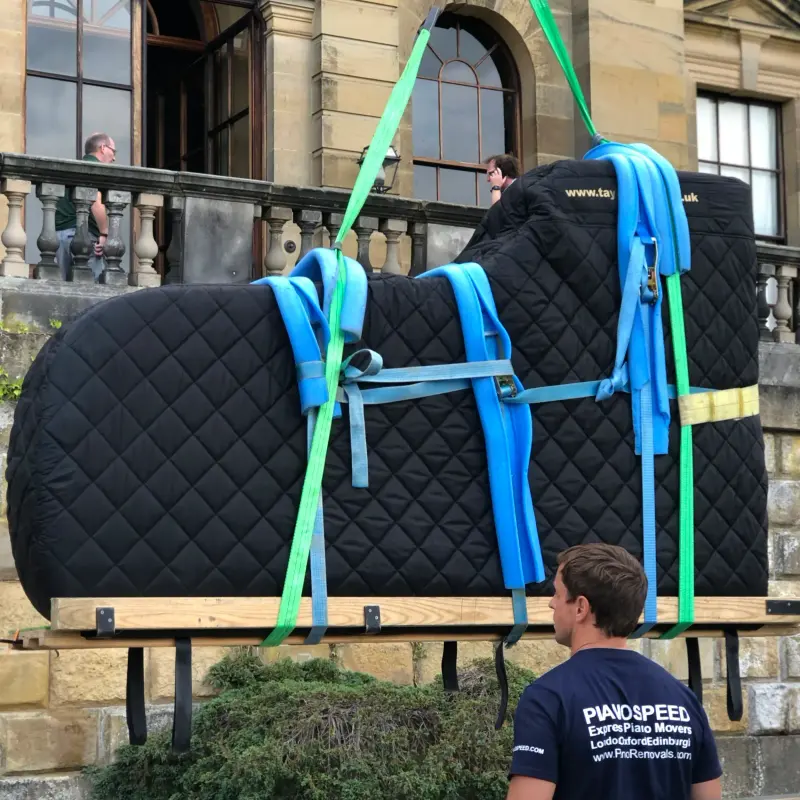
Where a staircase move is not possible, the alternative is a crane lift. The piano is rigged and raised externally through a window opening or over a balcony. The access is assessed and the method is confirmed before the day, so the price is fixed and there are no changes on the morning of the move. If your access is unusual, describe it accurately when you book.
At the destination
When the Bechstein arrives, the crew checks the route through the destination before anything comes off the vehicle. For a grand, the orientation of the case on the skid board determines the entry into the room and the direction the body tips when the legs are reattached. This matters in rooms with limited turning space or a low ceiling above the intended position of the piano, and it is worth thinking through in advance.
The legs go back on in reverse order to removal: the two side legs first, then the single keyboard-end leg last once the body is stable on both sides. The lyre is reattached once the body is sitting level. Transit covers come off last. Any surface marks noticed at delivery should be documented before the crew leaves.
After the move: settling and tuning
Every piano needs time to settle in a new room before a tuning will hold reliably. For a Bechstein, most piano technicians recommend waiting two to four weeks. The instrument needs to equilibrate to the temperature and humidity of the new space before the wood is stable enough to hold pitch between appointments.
Bechstein grands are particularly sensitive to humidity shifts. The soundboard, bridges and pin block will adjust over the first few weeks after the move, and tuning before that adjustment is complete often results in the pitch drifting again before the next visit. If the piano has come from a property with a different heating setup, from a different part of the UK, or from storage, allow more time rather than less.
When you book the tuner, tell them the piano has recently moved. A technician who knows the instrument has just arrived can assess the action regulation alongside the pitch and advise on whether anything needs attention beyond a standard tuning. For a concert-standard preparation or for a high-value Bechstein that has covered a long distance, a Bechstein-trained technician is the appropriate choice.
For a fixed price on moving your Bechstein, go to book.pianospeed.com and describe the access accurately at both ends. Piano moves start from £125. You can also call 020 7164 0000. PianoSpeed is rated 4.9 out of 5 on Trustpilot from 77 reviews, all from real piano moves across London, Surrey and the UK. PianoSpeed London Limited, 71-75 Shelton Street, Covent Garden, London WC2H 9JQ.
Book your move in 2 minutes
When it has to arrive perfectly, there is no second choice.
Get an instant quote★★★★★ Rated 4.9 out of 5 on Trustpilot from 77 reviews