
Blog · 19 September 2026
Moving a piano into a listed building: permissions access and care
Moving a piano into a listed building rarely requires formal consent for the move itself. Listed building consent covers physical alterations to a building's fabric, not furniture deliveries or removals. The practical challenge is different: listed buildings typically have narrower doorways, steeper original staircases, irreplaceable plasterwork and no lift. A specialist piano crew treats these as access and protection questions, and plans the route to the instrument's new room before a single blanket is laid. If access requires temporarily removing a fixed architectural element such as a door frame or a sash window surround, that is when to take advice from the building's owner, freeholder or the local authority conservation officer. For a fixed price on your move, get an instant quote at https://book.pianospeed.com in about two minutes.
Does moving a piano into a listed building need formal consent?
Listed building consent is required for works that alter, extend or demolish a listed building or any object or structure fixed to it. Delivering or removing a piano does not alter the building. No consent is needed simply to move an instrument in or out.
Where a grey area arises is if the only viable access route requires temporarily removing something fixed to the building: a wide door frame, a ground-floor window, or an internal shutter. In those cases, discuss the specific element with the building's owner or managing agent before the crew arrives. In practice, specialist piano crews rarely need to remove architectural elements. More often the answer is a different route, a different crew approach, or a window route that opens without disturbing the frame.
If you are a tenant in a listed building, check with your landlord or managing agent before the crew visits. This is less about consent and more about making sure the right people know the plan and can confirm access.
Access challenges in period and listed buildings
The practical challenges of a listed building move fall into a handful of categories that a specialist crew has seen many times.
Doorway widths
Original Georgian and Victorian internal doorways are typically 762mm to 838mm clear of the frame. A standard upright piano is 550mm to 600mm deep, which means it can usually pass through when positioned correctly. A baby grand on its side, legs removed, is a tighter calculation. Wide grands need a wider opening or a different route entirely. The crew measures every threshold before the piano moves.
Period staircases
Victorian terrace staircases are often narrower than their modern equivalents, with tighter turns at each half landing. The original balustrade may be ornate and irreplaceable. Stair access is chargeable, and a particularly narrow or steep flight requires a larger crew. Describe the staircase when you book, and the quote will reflect the actual job.
Ceilings and proportions
Reception rooms in Georgian townhouses often have generous ceiling heights, which helps when repositioning an upright near the top of a flight. Basement conversions and attic rooms can be the opposite: low beams, restricted headroom, or a ceiling so close to the stair soffit that the piano cannot travel vertically through the turn. The crew assesses headroom as part of planning the route.
No lift
Most listed buildings that predate the twentieth century have no passenger lift, and installing one typically requires consent. Every floor above ground level is a stair access job. Access including stairs and floor level is priced automatically when you describe it at booking.
Long carries
Parking restrictions around listed buildings in conservation areas are common. Where the van must stop at a gate or road end, the piano travels on its skid board across whatever is underfoot: cobbles, gravel, tiled paths, stone sets. The crew bring hard floor protection to cover these surfaces where needed.
Protecting the building alongside the piano
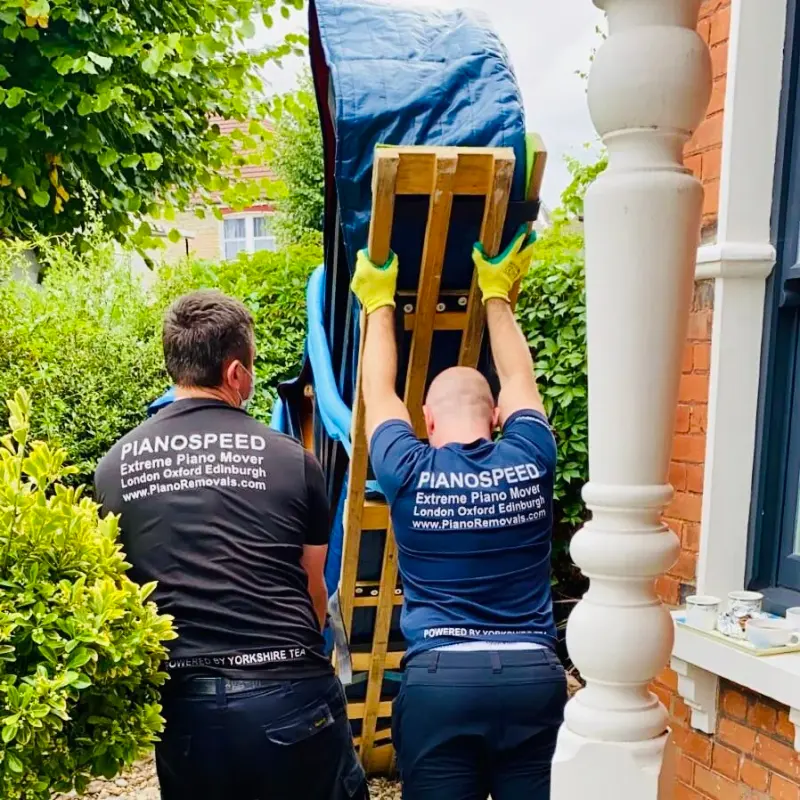
A specialist crew is responsible for both the instrument and the property. In a listed building that responsibility is especially clear because the features they are protecting are irreplaceable.
- Heavy floor protection goes down before any equipment enters: hardboard or heavy-duty ram board over original quarry tiles, parquet, encaustic tiles and flagstone floors
- Padded rail protectors go on door architraves at every tight threshold before the piano passes through
- The piano travels under the crew's full control at all times; nothing approaches a plaster cornice, coving, dado rail or picture rail under momentum
- Original banisters and balustrades are architectural features, not support structures for the crew; no weight bears on them at any point
- The route through the building is walked and measured before the piano moves, not improvised on the day
The triple-thickness fitted transit covers that travel with every piano also protect the instrument from contact with wall surfaces in tight corridors. The covers are fitted to the specific instrument shape, so there is no loose material to catch on a moulding or a doorknob.
Grand piano access in listed buildings: when the window is the right route
Many listed townhouses and period villas were built when a drawing room piano was part of the household. Large sash windows at reception level were sometimes the original delivery route, and they can still serve that purpose today.
Where a staircase or corridor route is not viable for a grand, the window route is the first alternative to assess. The crew looks at the window dimensions, the external access below, and the clear height from the sill to the ceiling. Some window routes work with the crew and a furniture hoist. Others, where the window is high above a hard surface and the piano is a full concert grand, may require a crane. Neither approach alters the building. Both require the window to be opened and left clear for the delivery.
Window and crane routes are not standard quote items but can be discussed with the team at 020 7164 0000 before you book. Arrange the survey early: crane access requires more lead time than a standard stair move.
Frequently asked questions
Does a piano move into a listed building need planning permission?
No. Planning permission and listed building consent cover physical alterations to the building's structure or fabric. Delivering or removing a piano is not an alteration. Consent is not required for the move itself. If access involves temporarily removing a fixed architectural element, discuss that specific element with the building's owner or local conservation officer.
Is stair access in a listed building charged differently?
Stair access is chargeable for any property, listed or not, and the charge reflects the crew size and time the stair work requires. A narrow or steep period staircase may require an additional crew member, which affects the price. Describe the staircase as accurately as you can at booking and the quote will reflect it. There are no day-of additions if the access matches what you described.
Can a grand piano fit through a Georgian townhouse door?
It depends on the door width and the piano's dimensions. Many Georgian reception room doorways are wide enough for a baby grand or a small grand once the legs are removed and the body is on its side. A concert grand or a large nine-foot instrument needs a wider opening or a window route. The crew will assess the dimensions before confirming the access method.
How does the crew protect original floors?
Heavy-duty floor protection goes down before any equipment enters the room. Skid boards are padded, and nothing drags on a tiled, parquet or stone floor. The crew lift the piano where the route requires it and roll it only on protected surfaces.
Who is responsible if something in the building is damaged?
PianoSpeed is fully insured. The specialist crew carries insurance that covers the piano and the property during the move. Describe the building's features accurately when booking so the crew arrives with the right protection materials and crew size for the job.
Do I need to tell anyone else about the piano move?
If you are a tenant, tell your landlord or managing agent that a specialist crew will be attending and confirm access arrangements. In a block of flats, the building manager may need to know that a large item will be travelling through shared areas. In a conservation area with parking restrictions, check whether the crew can obtain a temporary parking dispensation and arrange it before the day.
Piano moves start from £125. For a fixed price on your listed building move, get an instant quote at https://book.pianospeed.com. For access questions specific to a period property, including window routes, stair assessments, and floor protection, call 020 7164 0000. PianoSpeed is rated 4.9 out of 5 on Trustpilot from 77 reviews. PianoSpeed London Limited, 71-75 Shelton Street, Covent Garden, London WC2H 9JQ.
Book your move in 2 minutes
When it has to arrive perfectly, there is no second choice.
Get an instant quote★★★★★ Rated 4.9 out of 5 on Trustpilot from 77 reviews