
Blog · 12 November 2026
Moving a Roland or Korg stage piano: what a specialist does differently from a removals firm
Moving a Roland or Korg stage piano safely comes down to two things the instrument's design does not solve on its own: keeping the key surface free of load throughout the journey, and protecting the control surface and display from contact and vibration. A Roland RD-2000, RD-88 or Korg SV-2 or Grandstage 88 is built to travel between venues, but that design assumes the instrument is padded correctly, carried in the right orientation, and loaded into a vehicle where nothing bears down on the keys or against the panel. When a general removals firm handles the job, those assumptions are rarely met. For a fixed price on moving your Roland or Korg stage piano, go to book.pianospeed.com or call 020 7164 0000.
Why key orientation matters in transit
The key mechanism on a professional stage piano is built to respond to touch. On instruments like the Roland RD-2000 with PHA-50 Progressive Hammer Action, or the Korg Grandstage 88 with its Real Weighted Hammer Action, the action is calibrated to register graded response across 88 keys. That calibration relies on no unintended forces acting on the keys during transport.
When a stage piano is laid face-down in the back of a van, or when heavy items are placed on top of the key surface, the keys register sustained contact and the internal mechanism experiences load it was not designed to carry. On a short local move in a padded van with nothing else aboard, this risk is low. In a general removals van with other items loaded against or on top of the instrument, the risk is real and the damage is expensive to put right.
Carrying the instrument keys-up, padded on all faces, with nothing pressing against the key surface or the panel, is the correct method. This is routine on a specialist piano move and not always the case on a general removals job.
The control surface and display
Stage pianos at the Roland RD and Korg SV or Grandstage level have substantial control surfaces: sliders, assignable knobs, scene buttons and, on some models, a colour touchscreen display. These are not designed to take lateral force or contact from adjacent items in transit.
Before the instrument leaves the collection address, any loose items, music stand attachments and dust covers should be removed. The control surface is padded before the transit cover goes on. Where a display or specific knob cluster is particularly vulnerable to contact during a doorway passage or when loading into the vehicle, additional padding is applied. The instrument is not moved with its own accessories in contact with the panel.
A general removals crew working from a written inventory of a studio or home contents is not necessarily thinking about which surface of the instrument is fragile. A specialist crew is.
Weight and the two-person rule
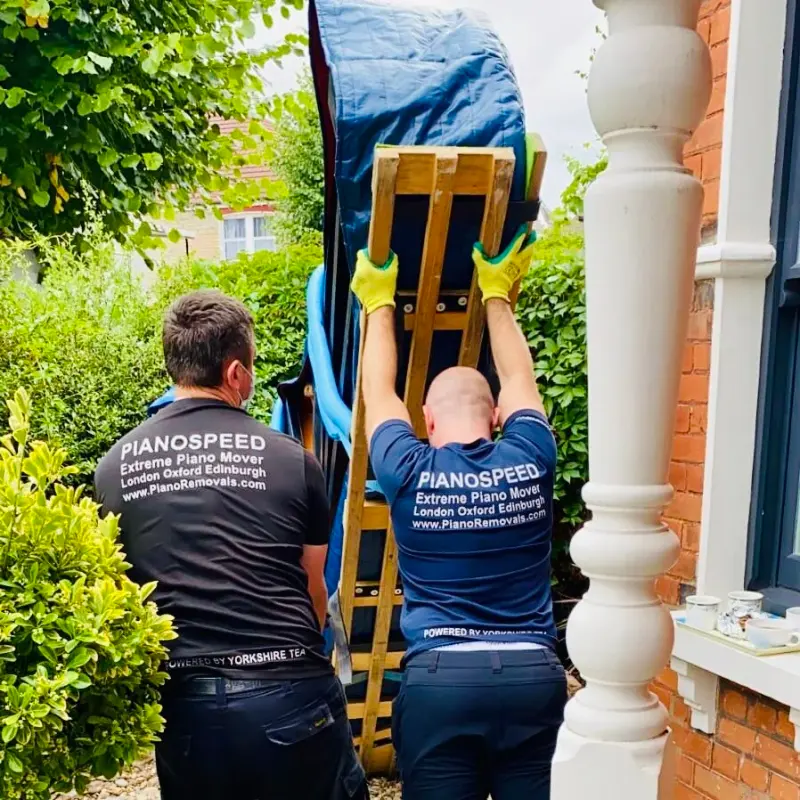
An 88-key stage piano is a heavy object. The Roland RD-2000 weighs around 23 kg; the Korg Grandstage 88 weighs around 28 kg. Neither is a one-person carry, and both require proper technique through doorways, on stairs and when loading into a vehicle. The weight is real enough that the natural instinct when tired is to set the instrument down quickly on the first available surface, which is frequently the wrong one.
A specialist crew prepares for the weight before the job, confirms the access route in advance, and uses a padded board to move the instrument through the property rather than hand-carrying it over distance. This reduces the risk of the instrument being set down unexpectedly on a surface that could damage the keys or casing.
Stairs
Stairs are chargeable for stage piano moves as they are for any piano move. Because the instrument has no legs to remove and is narrower than an upright acoustic piano, many residential staircases are physically manageable. The 23 to 28 kg weight still makes the job a minimum two-person operation on any staircase, and a tight half-landing turn or a low ceiling at the top of the flight should be described accurately when booking so the method can be confirmed beforehand. The stair charge is calculated automatically at book.pianospeed.com when you enter the floor level.
If your stage piano is already in a flight case
Many touring musicians and studio owners store their Roland or Korg stage piano in a heavy-duty ATA flight case. If your instrument is in a case, the handling is straightforward: the case travels in its normal orientation, padded against the vehicle sides and secured. The case is not stacked and nothing is loaded on top of it.
If your instrument does not have a flight case, the transit cover used by a specialist piano mover provides equivalent padded protection for a domestic or studio move. It is fitted, not loose, which means it stays in contact with the finish throughout the journey and prevents the kind of contact marks that blanket wrapping can leave on polished surfaces.
What to tell the specialist when you book
When booking a Roland or Korg stage piano move, the useful details to provide are:
- The make and model (Roland RD-2000, RD-88, Korg SV-2, Korg Grandstage 88, and so on).
- Whether the instrument is in an ATA flight case or will travel loose in a transit cover.
- The floor level at both ends, the number of stairs, and whether a passenger lift is available.
- Doorway widths at both ends if the access is tight.
- Whether the instrument has built-in speakers, since some models include them and others are silent stages.
With accurate access information, the price at book.pianospeed.com is the price on the day. There are no adjustments on arrival when the details are entered correctly.
Frequently asked questions
Does a Roland or Korg stage piano need a specialist piano mover?
It depends on how it is being moved and what else is in the vehicle. A specialist is worth using when the stage piano is being moved alongside other heavy furniture or equipment, when stairs are involved, or when the access is tight enough that a one-person carry is not safe. If the instrument is already in an ATA flight case and you are moving it alone in a car or small dedicated van, the case provides the protection. PianoSpeed handles stage piano moves as part of studio clearances, home moves and instrument deliveries.
Can a stage piano travel on its side?
No. Keep the instrument keys-up throughout the move. Laying a stage piano on its face or back puts load on the key mechanism and control surface that those components are not designed to carry during transit. A specialist crew loads it in the correct orientation and secures it so it does not shift.
Will the keys be damaged if the piano is laid face-down?
Possibly, depending on the duration and the surface. The key action on a Roland RD-2000 or Korg Grandstage 88 is a precision mechanism. Sustained pressure from a flat surface pressing against 88 keys is not normal operating load for it. Short-duration contact is less likely to cause permanent damage than extended pressure during a long journey, but it is worth avoiding entirely by keeping the instrument keys-up from the start.
Do stairs cost extra for a stage piano move?
Yes. Stairs are chargeable on any piano move, including stage pianos. The charge is calculated automatically in the online booking at book.pianospeed.com when you enter the floor level and whether a passenger lift is available.
What is the difference between moving a stage piano and a Clavinova?
A Clavinova or full-cabinet digital piano has legs and a pedal unit that are removed before the cabinet is padded for transit, and the cabinet is a large piece of furniture with built-in amplifiers. A stage piano has no legs to remove, is narrower, and travels more like heavy portable electronic equipment, with the specific requirement that the keys face upward throughout. The underlying principle is similar: keep the instrument in its correct orientation, pad it properly and load nothing against the vulnerable surfaces.
Can PianoSpeed collect a stage piano from a rehearsal studio or venue?
Yes. PianoSpeed collects from rehearsal studios, recording studios, schools, venues and private addresses across London, Surrey and the UK. If the collection address has restricted parking or specific unloading hours, provide those details when you book so the crew plans the visit accordingly.
For a fixed price on moving your Roland or Korg stage piano, go to book.pianospeed.com and enter the make, model and access details at both ends. Piano moves start from £125. You can also call 020 7164 0000. PianoSpeed is rated 4.9 out of 5 on Trustpilot from 77 reviews, all from real piano moves across London, Surrey and the UK. PianoSpeed London Limited, 71-75 Shelton Street, Covent Garden, London WC2H 9JQ, part of the Pianospeed Group.
Book your move in 2 minutes
When it has to arrive perfectly, there is no second choice.
Get an instant quote★★★★★ Rated 4.9 out of 5 on Trustpilot from 77 reviews