
Blog · 4 November 2026
Moving a piano left behind after a house purchase: what buyers need to know
Complete on a property and find a piano in it, and the first question is not logistical but legal: does it belong to you? A piano is a chattel, not a fixture, so it does not transfer with the property automatically. If the sale explicitly included it, the instrument is yours. If it was not listed as included and the sellers left it behind, they still own it and need to arrange collection. For specialist collection, removal or storage of an inherited piano, get a fixed price at book.pianospeed.com.
Fixtures, chattels and what your solicitor should have covered
In English and Welsh conveyancing, every significant item of furniture or equipment is recorded on a fixtures, fittings and contents form. The standard form is the TA10. It lists which items are included in the sale, which are excluded and which are negotiable. A piano is a chattel, not a fixture, so it must be listed on the TA10 to transfer with the property. If it is not listed, or if it appears as excluded, the sellers should have removed it before you completed.
The first practical step is to find the TA10 in your conveyancing documents and check whether the piano is listed as included. This should take no more than a few minutes. If it is listed as included, the piano is yours and your decision is what to do with it. If it is listed as excluded, or missing from the form entirely, the piano is still the sellers' property.
When the piano was left without agreement
If the TA10 does not include the piano and the sellers left it behind anyway, contact their solicitor promptly in writing. Keep copies of all correspondence. Set out clearly what you found, where it is in the property, and ask for collection to be arranged within a reasonable timeframe. Twenty-one days is a sensible starting point. The obligation to remove it and the cost of doing so sit with the previous owners, not with you.
Until the piano has been formally collected or abandoned, do not move it, sell it, donate it or allow it to be used without the owner's consent. Moving someone else's piano without permission creates liability for any damage that occurs. The safest course is to leave it where it stands until ownership is clearly resolved.
If the sellers cannot be contacted directly, their solicitor has an ongoing duty to pass correspondence on. If a reasonable period passes without collection or any communication, you can explore the route provided by the Torts (Interference with Goods) Act 1977, which covers abandoned goods. That route has specific steps and timings, so seek legal advice before proceeding.
When the piano was included in the sale
If the TA10 listed the piano as included, the instrument is yours from the moment of completion. That changes the question entirely: not ownership, but what you want to do with it.
- Keep and use it: if the piano is in reasonable condition, it may be a genuinely useful addition; have a piano technician assess and tune it before you play it regularly, since instruments that have stood unplayed for some time often need work before they respond reliably
- Move it to a different room within the property: a specialist crew can relocate the piano safely inside your home, including up or down stairs, without risk to the instrument, the floors or the doorframes; stair access is chargeable
- Sell it: a piano left by previous owners is sometimes valuable, sometimes not; a piano dealer or auction house can give you a valuation quickly and may collect from the address if the instrument is saleable
- Donate it: schools, community groups and piano charities sometimes accept instruments, with condition being the main deciding factor; collection timelines are set by the recipient and cannot usually be rushed
- Move it into storage: if you are not ready to decide or are renovating before moving in fully, climate-controlled piano storage is available and keeps the instrument in stable condition while you work out your plans
- Arrange responsible disposal: if the instrument has no practical value and no recipient, a specialist can collect and dispose of it; ask specifically about the disposal route if this matters to you
Checking condition before you decide
A piano that has stood in an unheated or under-heated room for a long period may have suffered humidity damage to the soundboard, loose strings or action problems that are not apparent until someone plays it. Before you invest in moving it to a new position or restoring it, it is worth having a piano technician spend an hour with it. That assessment will tell you whether the instrument is worth the ongoing cost of moving, tuning and maintenance, or whether storage or disposal is the more practical outcome.
If you decide the piano is worth keeping, the move to its permanent place in the property can often be coordinated on the same day as the technician visit if you book both in advance. Specialist crews work alongside technicians regularly.
What specialist removal involves
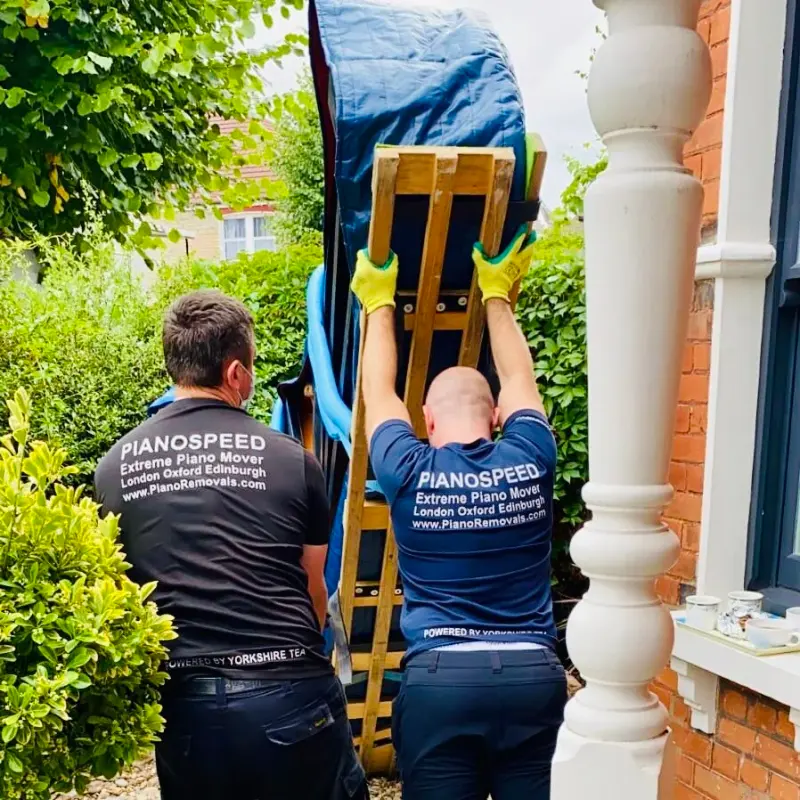
Whether you are moving the piano out of your new property or repositioning it within it, the same equipment applies. An upright piano weighs between 150 and 300 kilograms depending on the model. It needs a fitted transit cover, a piano skid board, the right carrying straps and a crew trained in navigating hallways, doorways and stairwells without putting pressure on the case or the pedal lyre.
A general removal van is not suitable for this job, and a general removals team will not have the specific equipment. If the previous sellers are arranging collection and you have any say in the matter, suggest they use a specialist piano mover rather than whoever is packing the rest of their goods. An instrument moved incorrectly out of a property you now own creates a dispute about property damage that you do not need.
If the piano is yours and you want it removed, the booking process is straightforward. Enter the floor level at collection, the destination address and any stair access, and the full fixed price is calculated automatically at book.pianospeed.com. Piano moves start from £125.
Questions about a piano left in a property you have purchased
Is a piano left in a house I have bought legally mine?
Only if the sale included it explicitly on the fixtures, fittings and contents form. A piano is a chattel and does not transfer automatically with the property. Check the TA10 from your conveyancing documents. If the piano was not listed as included, it still belongs to the seller.
What should I do if the sellers left a piano without agreement?
Contact the sellers' solicitor in writing, explain what you found and ask for collection to be arranged within a defined and reasonable period. Keep all correspondence. Do not move or dispose of the piano until ownership is resolved. If collection is not arranged after a reasonable notice period, seek legal advice on the abandoned goods route before taking any further steps.
Who pays for collecting a piano the sellers left behind?
The sellers do. The obligation to remove their own chattels before completion rests with them, and so does the cost. If collection is arranged through a specialist mover, the sellers should be paying that invoice. If they refuse and you have to arrange removal yourself to regain full use of the property, document everything and seek legal advice on recovering the cost.
How much does it cost to have the piano moved?
Piano moves start from £125. The final price depends on the floor level at collection, the destination and any stair access required at either end. Stair access is chargeable and is included in the automatic price calculation at book.pianospeed.com.
Should I have the piano tuned before moving it to a new room?
In most cases, no. A piano that has stood unused for a long period may need several tuning sessions to reach pitch safely, and any subsequent move will cause it to settle again and go out of tune. The standard advice is to move the piano first, let it settle for four to six weeks in its final position, and then have it tuned. Tuning before a planned move is usually wasted.
Can I donate a piano that was included in my house purchase?
Yes, if it was included in the sale it is yours to donate. Schools, hospices, churches and community music groups sometimes accept pianos, but they set their own collection timelines and have specific condition requirements. Contact potential recipients before you commit to a date, since collection can take several weeks to arrange and instruments in poor condition are rarely accepted.
Get a fixed price for collecting or moving your piano
Whether you need a piano collected from a property you have just purchased, moved to a different room within it or taken into storage while you decide, the full price including stair access at both addresses is calculated automatically when you book. Piano moves start from £125. Get an instant quote at book.pianospeed.com or call 020 7164 0000 to talk through the options. PianoSpeed London Limited, 71-75 Shelton Street, Covent Garden, London WC2H 9JQ, is rated 4.9 out of 5 on Trustpilot from 77 reviews.
Book your move in 2 minutes
When it has to arrive perfectly, there is no second choice.
Get an instant quote★★★★★ Rated 4.9 out of 5 on Trustpilot from 77 reviews