
Blog · 25 October 2026
What to do with a piano you cannot sell: moving, donating or storing it
If you have listed your piano, had no serious enquiries, and the instrument is still sitting in a room you need back, the situation is a familiar one. More uprights are looking for homes than there are households that want them. The three realistic paths forward are donating to an organisation that will use it, putting it in specialist storage while you work out a longer-term plan, or arranging responsible disposal. Each path involves a specialist move. For a fixed price and a confirmed collection day, get an instant online quote at book.pianospeed.com.
Why pianos are hard to sell
The UK has more uprights available than it has buyers. Decades of manufacture combined with a long-running decline in the number of households with a regular player means supply runs consistently ahead of demand at the lower end of the market. A standard upright in average condition will often attract no serious offers on the usual listing sites, even at a nominal asking price.
The reasons vary by instrument. Older pianos with worn hammers, broken strings or stiff keys that have not moved in years have limited practical value until a technician restores them, and most private buyers are not willing to take on that cost or uncertainty. Larger uprights can also be genuinely awkward to accommodate in modern houses and flats. A piano that was the centrepiece of a Victorian drawing room can be a difficult fit in a three-bedroom semi with narrow hallways and carpeted stairs.
None of this means the piano is worthless, but it does mean the sale route sometimes leads nowhere. When that happens, the practical question is what to do next.
Option one: donate the piano to an organisation that will use it
Donating is the most common route, and it works well for a piano that is playable or close to playable. State primary and secondary schools with an active music service are a reliable first contact. Music charities working with young people, churches and chapels, community centres, care homes and hospices running activity programmes all have ongoing need for acoustic uprights.
The practical steps are straightforward. Confirm that the piano is in a condition the recipient will accept. Approach two or three organisations with the key facts: the make and model, the approximate age if known, the address and the access at the collection point. A brief description of any stairs, narrow doorways or limited parking helps the recipient understand the logistics from the outset.
The question of who pays for the move is best settled at first contact. Some well-funded schools and music charities cover the cost of a specialist collection. Most community organisations expect the donor to arrange it. Agreeing this before any booking is placed avoids confusion later about who is responsible for the payment. Our detailed guide on how to donate a piano covers the process step by step, including which types of organisation to approach and how to frame the initial conversation.
Option two: specialist piano storage
If you are not ready to part with the piano, or if the house move, renovation or probate process means you need the instrument out of the way temporarily, specialist piano storage is a practical option. A piano needs controlled temperature and humidity to remain in playable condition. A standard self-storage unit does not provide this, and an instrument that has spent a year in an uncontrolled environment often emerges in noticeably worse condition than when it went in.
The Pianospeed Group's specialist piano storage service operates at pianostorage.co.uk. Instruments are held in a humidity-controlled facility on padded cradles, not stacked on shelving or left on cold concrete. The same piano-trained crews who carry out collections also handle the movement into and out of storage, so the instrument is in specialist hands at every stage.
Storage works well for an executor dealing with a probate property who is not yet certain of the piano's future, for a downsizer moving to a smaller property where the piano will not fit, or for a household mid-renovation where the piano needs to leave the house for several months. It is also a useful holding position while you wait for a donation recipient to confirm they can take the instrument.
Option three: responsible disposal
Some pianos have reached the end of their useful life. An instrument that has spent years in damp conditions, has a cracked soundboard, severely corroded strings throughout, or mechanical failures affecting most of the keyboard, is unlikely to find a recipient willing to take it on. Responsible disposal is the appropriate route in these cases, and it is more common than many owners expect.
A piano cannot go in a skip or be left out for a household waste collection. The cast-iron plate alone typically weighs over 100 kg. The strings, felts and older lacquers used on some instruments require careful handling. The correct approach is a specialist collection, after which the piano goes to a workshop where any usable parts are salvaged and the remaining material is handled responsibly. This is a legitimate and fully insured service; it is not a last resort so much as the right practical answer for a piano that is genuinely beyond restoration.
What all three paths have in common
Regardless of where the piano ends up, the next step in all three cases is a specialist move. A piano is not a piece of furniture that a general removals firm or a man with a van can handle without risk. An upright typically weighs between 180 kg and 300 kg. Moving one incorrectly risks injury to the crew, damage to the instrument and damage to the walls, floors and banisters of the property.
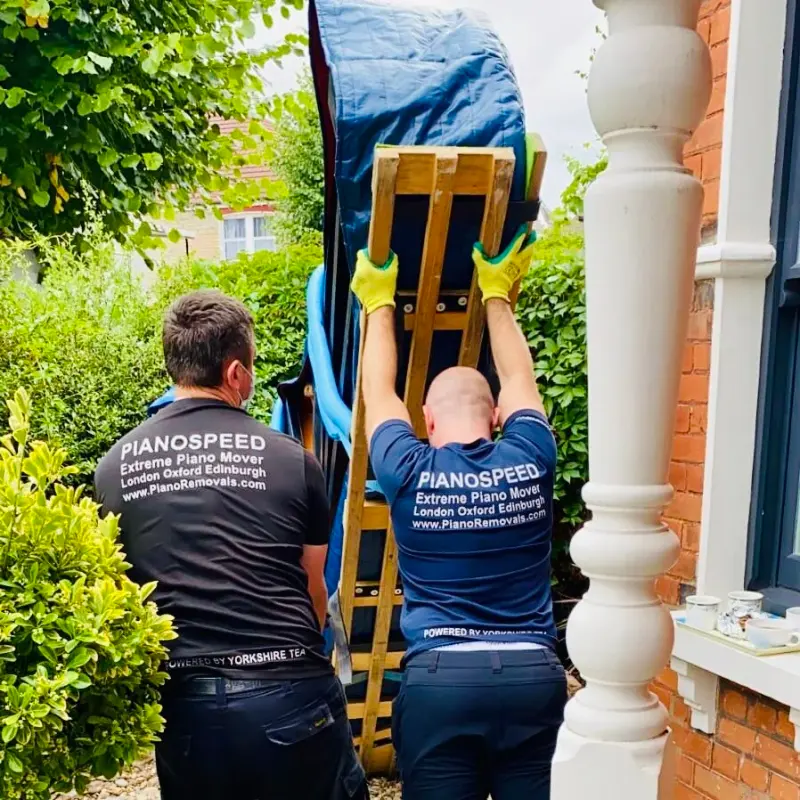
Piano-trained crews use triple-thickness fitted transit covers tailored to the instrument, a padded skid board for transport, and the equipment to manage stairs and tight access. On a grand, the legs and pedals come off individually, wrapped in padded bags, and the instrument travels on its side in a heavy-duty crate. This is specialist work. A crew that does it correctly also carries full insurance for the piano and for the property throughout the move.
Stairs are chargeable at both the collection and the delivery addresses. Access including floor level is priced automatically in the online booking form at book.pianospeed.com once you describe the access at each end. Piano moves start from £125 for a straightforward ground-floor job. For a fixed price covering the specific addresses and access in your situation, the instant quote at book.pianospeed.com takes under two minutes.
Common questions
Can I sell a piano that needs work?
You can attempt to, but the realistic market is narrow. A piano dealer may offer a nominal amount for an instrument with genuine restoration potential, and a specialist auction house occasionally handles older pianos that the right buyer will invest in. For most domestic uprights in average or below-average condition, private buyer interest is typically limited. A piano tuner's written condition report can help a potential buyer understand exactly what they are taking on, and sometimes produces a serious enquiry where a listing alone did not.
Who typically pays for a donation move?
There is no standard convention. Some schools and music charities with established relationships with piano movers can arrange their own collection. Most community organisations, care homes and smaller charities do not have that arrangement in place and expect the donor to organise the move, or for both parties to agree a cost split. Settling this at first contact, in writing if the amounts involved are significant, avoids any misunderstanding when the booking is placed.
How long can a piano stay in specialist storage?
There is no fixed upper limit. Pianos in long-term specialist storage remain playable and in good condition for years, provided the facility maintains stable temperature and humidity throughout. Short-term storage during a house move and longer-term storage during uncertain circumstances are both practical uses. Contact pianostorage.co.uk for current terms and availability.
What if no donation recipient accepts the piano?
Responsible disposal is a legitimate and increasingly common outcome for large uprights and older instruments in poor condition. The collection and disposal are handled by a specialist piano crew. The piano does not need to be in playable condition for a collection to go ahead; the specialist simply needs accurate information about the access at the collection address.
Do you move pianos in Northern Ireland?
Yes. PianoSpeed operates a dedicated Belfast-to-England lane and moves pianos throughout Great Britain and Northern Ireland. Donation collections, storage transfers and disposal collections are all handled within this coverage area.
Book a specialist piano collection
If you have a piano you cannot sell and need it moved, donated or stored, the first step is an instant fixed price at book.pianospeed.com. You can also call PianoSpeed London Limited on 020 7164 0000. The office is at 71-75 Shelton Street, Covent Garden, London WC2H 9JQ. Rated 4.9 out of 5 on Trustpilot from 77 reviews. Specialist piano storage is available at pianostorage.co.uk. PianoSpeed is part of the Pianospeed Group.
Book your move in 2 minutes
When it has to arrive perfectly, there is no second choice.
Get an instant quote★★★★★ Rated 4.9 out of 5 on Trustpilot from 77 reviews