
Blog · 16 October 2026
Piano moving for estate agents and lettings: how to handle an instrument left in a property
When a tenant hands back the keys and leaves a piano behind, the letting agent or landlord has a practical problem that no general clearance firm is equipped to solve. Pianos weigh between 180 and 500 kilograms, require a trained crew, specialist equipment and careful handling, and will damage walls, floors and banisters if moved incorrectly. PianoSpeed handles these calls regularly, covering London, Greater London, Surrey and the GB mainland, plus Belfast and Northern Ireland. Piano moves start from £125 and the fixed price is at book.pianospeed.com.
When a tenant leaves a piano behind
Under most standard tenancy agreements, goods remaining in a property after the tenancy end date become abandoned property. The landlord or agent is generally required to follow an abandoned goods process: written notice to the former tenant's last known address or forwarding address, and a reasonable period to arrange collection.
During this period the instrument technically remains the tenant's property. It should not be disposed of, sold or given away without following the correct procedure. For any piano of potential value, seek written confirmation from your solicitor before proceeding. This protects both the landlord and the agent if the former tenant later raises a claim.
Once the notice period has passed and no collection has been arranged, many landlords appoint PianoSpeed to remove the instrument. The booking team can arrange access through the letting agent directly and provide a fixed price on the basis of photos if a physical survey is not practical.
When a piano is left after a property sale
In a residential sale, the position of every significant item of furniture or equipment should be recorded in the fixtures, fittings and contents form. A piano that was not listed as included in the sale and not removed before completion remains the vendor's responsibility. The buyer does not have to accept it.
In practice, pianos are sometimes overlooked in the paperwork and discovered after keys are handed over. Acting agents should flag this to both parties as early as possible. Trying to arrange a piano removal under pressure from a completion date or a re-let deadline is exactly when mistakes happen and property gets damaged.
The same applies when a landlord takes over management of a property and discovers a piano the previous manager or owner left behind. Documenting it on the inventory and clarifying ownership from the outset saves a more difficult conversation later.
Why a specialist crew is required
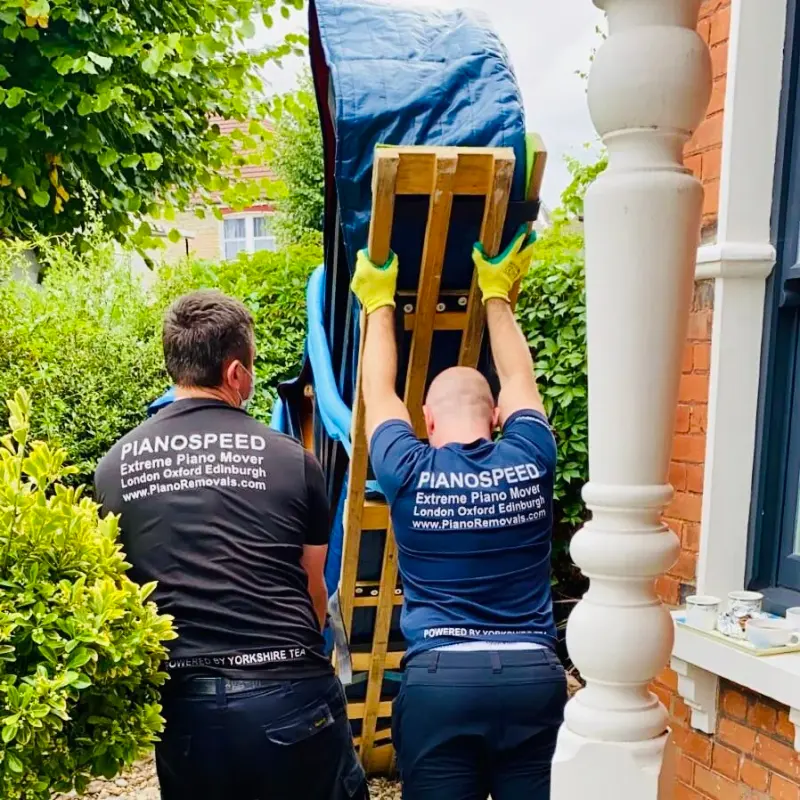
A piano is not furniture. An upright weighs between 180 and 280 kilograms. A baby grand weighs between 200 and 350 kilograms. A full-size concert grand can exceed 500 kilograms. Moving any of them safely requires a padded skid board, fitted transit covers, a trained crew who understands how the weight moves through a stairwell or corridor, and specialist equipment for the vehicle.
General clearance firms and standard removals staff are not trained for this work. The risks are real: a piano on a staircase that is not under full control can cause serious injury. Unprotected edges on a narrow Victorian stairwell will score walls and banisters permanently. Property managers who appoint an unqualified firm face difficult conversations with landlords and insurers when something goes wrong.
What to tell the booking team
The PianoSpeed booking team can confirm a fixed price from photos if a physical survey is not practical for the agent's timeline. The information the team needs:
- Type of piano: upright, baby grand, grand or digital
- Collection address and floor level
- Staircase configuration and any tight turns or low ceilings
- Whether there is a lift at the property
- Delivery destination, or whether the piano is going into storage
- Access arrangements and any entry restrictions
Access including stairs and floor level is priced automatically in the online quote at book.pianospeed.com. If you are managing the property remotely, the team can coordinate access through you or a keyholder on the day.
How the piano is protected during the move
Every piano PianoSpeed moves travels in a top-of-range, triple-thickness fitted transit cover tailored to the instrument. On a grand piano, the legs and pedal lyre are removed before the body goes into a heavy-duty crate. Legs and pedals go into individual padded bags. The piano travels on a padded skid board and is strapped securely in the vehicle throughout the journey.
This is specialist work that a general removals firm does not carry out. The crew is piano-trained, not general staff repurposed for an awkward clearance. The result is that both the instrument and the property are protected.
Options for the piano once it is removed
Once the piano is out of the property, the options are:
- Delivery to the former tenant's new address if they confirm where they want it
- Transfer to a piano dealer for inspection, valuation and potential resale
- Specialist piano storage at pianostorage.co.uk while ownership or next steps are resolved
- Donation to a school, music charity, hospice or community music group
- Disposal once a piano technician has confirmed the instrument is beyond economic repair
Specialist piano storage through the sister site pianostorage.co.uk is often the right interim step when there is an unresolved ownership question or when the beneficiary or buyer needs time to arrange delivery to their own property.
Frequently asked questions
Do we need a specialist if it is just an old upright in poor condition?
Yes. Age does not change the weight or the handling requirements. An old upright in poor condition can actually be harder to move safely than a well-maintained one, because the internal structure may be compromised. The crew and equipment requirements are the same.
Can PianoSpeed quote from photos rather than a site visit?
Yes. Send clear photos of the piano and the access route, including any stairs and the exit from the building, and the booking team will confirm a fixed price. You can also call 020 7164 0000 directly.
Who pays for the move when a tenant has abandoned a piano?
Any costs the landlord incurs in dealing with abandoned goods, including removal and storage, may be recoverable from the tenant's deposit subject to following the correct procedure and deposit scheme rules. Confirm the specific position with your solicitor and the deposit scheme before deducting anything.
Can the piano go into storage while we resolve who owns it?
Yes. The sister site pianostorage.co.uk provides specialist piano storage in a climate-controlled facility. The instrument can be collected and stored safely while the question is resolved, avoiding the risk of leaving a heavy valuable item in an empty or re-let property.
Do you work with letting agencies and property managers on account terms?
Yes. Agents and property managers who use PianoSpeed regularly can arrange invoiced account terms. Call 020 7164 0000 to discuss how this works in practice.
What happens if the piano is on an upper floor with no lift?
The crew is trained and equipped for multi-floor carries including tight Victorian staircases and period properties with low ceilings. Access including stairs and floor level is priced automatically in the online quote at book.pianospeed.com. Stairs are chargeable and will be reflected in the fixed price.
Book a specialist piano removal for your managed property
For an instant fixed price, go to book.pianospeed.com or call 020 7164 0000. PianoSpeed London Limited, 71-75 Shelton Street, Covent Garden, London WC2H 9JQ, is rated 4.9 out of 5 on Trustpilot from 77 reviews. For storage while ownership is resolved, go to pianostorage.co.uk. Part of the Pianospeed Group.
Book your move in 2 minutes
When it has to arrive perfectly, there is no second choice.
Get an instant quote★★★★★ Rated 4.9 out of 5 on Trustpilot from 77 reviews