
Blog · 11 September 2026
Why grand pianos are moved on their side and not flat
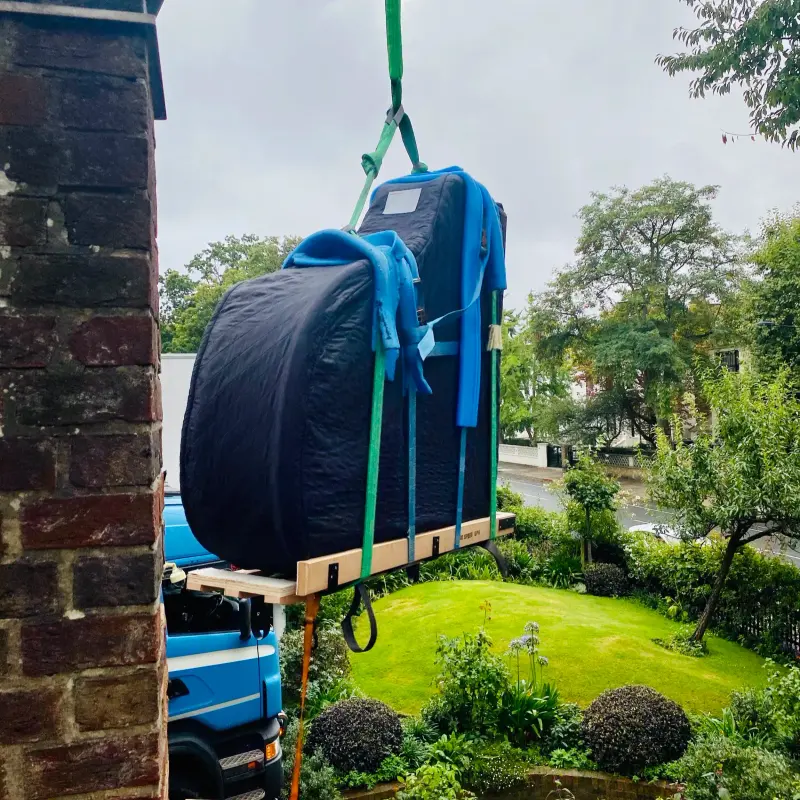
A grand piano is moved on its side, with the straight bass edge of the rim at the bottom, resting on a padded skid board. This is not a matter of convenience or vehicle height. The straight edge is structurally the strongest section of the case, the only face of the instrument designed to bear compressive load during transport. Moving a grand any other way puts stress on parts of the case that were never built to take it.
If you need a fixed price for moving a grand piano, go to book.pianospeed.com for an instant online quote, or call 020 7164 0000. The rest of this article explains the engineering reason for the method and what the crew does at each stage of the job.
The structure of a grand piano case
The case of a grand piano is not symmetrical. The lid, the curved treble side of the outer rim, and the keyboard end are all relatively lightweight parts of the casing designed for appearance and acoustic performance, not for load-bearing. The bottom of the case, above the pedals and between the legs, carries the iron plate and the heavy cross-bracing that anchor the string tension. The soundboard, the large board of precisely tapered spruce that sits visible under the open lid, is a precision-tuned resonating surface that cannot be compressed from the outside without changing its geometry and therefore its tone.
The one part of the case designed with a straight, rigid profile is the straight side: the bass edge that runs from the keyboard cheek to the tail of the piano. This edge is not a coincidence of the instrument's shape. The inner and outer rims on the bass side form a composite timber beam, laminated and glued, that is considerably thicker and stiffer than the curved treble rim. Piano makers reinforce this section of the case specifically because it carries internal structural load from the plate, the strings and the action frame above it. When the piano tips onto that edge and rests on a padded board, it is resting on the part of the instrument built to handle compressive stress.
Why not flat on its back?
Laying a grand piano flat, with the soundboard or the lid facing downward, puts the weight of the entire instrument onto surfaces that were built for neither position. The lid is a thin panel, often with a hollow profile at the edges, that opens to project sound into the room. It will flex and distort under the weight of even a small grand. The soundboard is more critical: it is a tapered board, thinner at the edges than at the centre, and it carries significant downward pressure from the bridge and the string tension above it. Adding compressive load from the outside face would distort the crown of the soundboard and alter the pre-tension built in during manufacture.
The flat orientation also puts the legs, or the leg-mounting points where legs have been removed, at the outside edges. Those points are not designed to be load-bearing in that direction. The risk is not hypothetical: it is why the sideways method for transporting grands has been standard practice for well over a century, and why a crew that tries to shortcut it with flat transport on a van floor is doing the job incorrectly.
Why not standing upright with legs on?
Moving a grand piano with its legs still attached would leave it very tall and top-heavy and would require a vehicle with a much higher interior clearance than most moving lorries offer. A 6-foot baby grand with legs attached stands over a metre high at the rim, and a concert grand is taller still. Securing an instrument that tall in a vehicle, without tipping it, requires an engineering approach that is not practical for a road journey. More significantly, the legs themselves are not designed to absorb road vibration and lateral forces in transit. They are precision-jointed parts with metal mounting bolts, and the joint between leg and body is a potential failure point if the instrument is not properly supported.
Removing the legs solves all of these problems at once. With the legs off, the piano sits flat on the skid board on its straight edge, reducing the overall height of the load and allowing it to be strapped and braced against the vehicle walls securely. The legs and lyre travel in padded bags inside a heavy duty crate, stowed separately in the vehicle.
What the crew does, step by step
Before the piano tips onto the skid board, the crew follows a fixed removal sequence. The fallboard, the hinged cover above the keys, is closed and secured. The music desk is unclipped and padded separately. The lid is lowered. Then the legs come off in a set order: the two curved-side legs at the treble end are unbolted first, and the single leg on the straight side is the last to be removed. The single leg is left until last because removing it too early leaves the body unsupported on the side it will tip toward.
The pedal lyre, the housing for the three pedals and the rod connections to the damper mechanism, is unbolted carefully from below the keyboard end. The rods connect internally to the action, so the attachment points are handled without stress. Once the legs and lyre are removed, the body rests briefly on a low padded trestle while the skid board is positioned. The piano is then tipped steadily onto its straight side, now the bottom face, and laid onto the board. A purpose-built padded skid board has a cushioned face that contacts the piano case and a wheeled or rollered underside that allows the instrument to be moved without dragging it. The whole assembly is strapped across the board before it moves from the room.
The transit cover
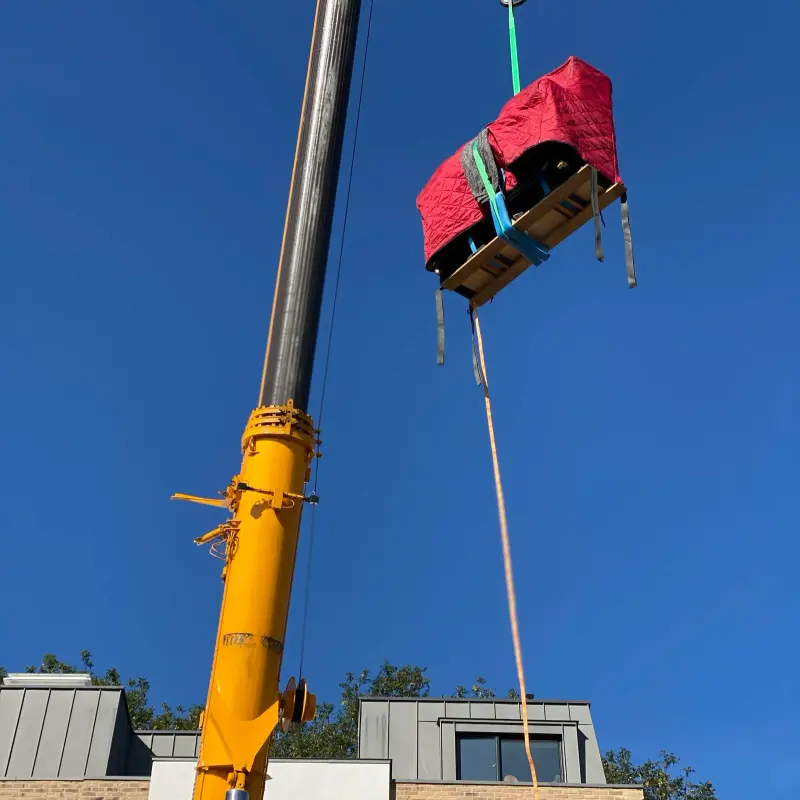
Once the piano is on the skid board, a fitted transit cover goes on before the instrument leaves the room. Triple-thickness and shaped specifically to the instrument, the cover protects the case from contact with doorframes, stair walls and the interior of the vehicle. For a polished ebony finish or a lacquered veneer, the cover surface needs to be smooth and even: a cover that bunches or creases against a high-gloss case can mark the finish in transit even without direct impact. The piano then travels in the vehicle with the covered side strapped against the inner wall of the lorry.
Reassembly at the destination
Reassembly follows the removal sequence in reverse. The pedal lyre goes back on first, then the legs: the single straight-side leg is the first to be reattached, raising the body off the skid board, and the two treble-side legs follow. This order matters because the single leg provides the fulcrum point as the body tips up, and having it in place first gives the crew control over the movement.
Before the transit covers come off, the crew checks the route and the room. The orientation of the piano on the skid board determines which direction it enters and which way it tips as the legs go back on. In a room with limited turning space, with a low ceiling section above the piano position, or with an awkward door angle, this is worth thinking through in advance. If you know the room dimensions and the position where the piano will live, tell the booking team when you call or note it on the online form.
Common questions about the method
Does the piano stay on its side for the whole journey?
Yes. The piano goes onto the skid board at the collection address and stays on it, on its side, until the legs are reattached at the destination. Loading, the road journey and unloading all happen with the instrument in the same position. There is no intermediate stage where it is stood upright.
Does lying on its side damage the action or the strings?
No, provided the move is carried out correctly. The action, the assembly of hammers, levers and dampers inside a grand, is bolted to the keybed and does not move independently of the case. The strings are under continuous tension at all times and are not affected by the orientation of the case during transport. The main precaution is to avoid impact to the keyboard end, and to ensure the dampers are not pressed against any surface during the move.
Does it matter which side faces down?
Yes, it is always the straight side, the bass side, facing down onto the skid board. The curved outer rim, on the treble side, faces upward during transport. This is consistent across all types and sizes of grand piano, from a small baby grand to a full concert grand.
Are there any grand pianos where this method does not apply?
The straight-side method is standard across all modern grand designs, from a Steinway Model S to a Fazioli F308 concert grand. Some historical instruments, square pianos and certain period fortepianos, have different case geometries and may need a different approach. For any piano made after the mid-19th century grand design settled into its current form, the method is the same regardless of make or model.
Do stairs affect how the piano is moved on the skid board?
The piano on the skid board is managed up or down stairs as a single unit, using stair-climbing equipment and crew positioning suited to the specific staircase. Stair access is always chargeable and is priced automatically in the online quote at book.pianospeed.com. The number of steps at each address, whether there is a half-landing, and the floor level at collection and delivery all affect the price and the crew configuration for the job.
How long does it take to remove the legs and lyre before moving a grand?
On a well-maintained piano with accessible leg bolts, the removal sequence at the collection address takes around fifteen to twenty minutes for an experienced crew. At the destination, reassembly takes a similar amount of time. If bolts are seized, if the lyre has a complex fitting arrangement, or if the access is very tight, the prep time extends accordingly. It is worth noting that the leg bolts on some older pianos can be damaged if forced, so a crew that has not moved a particular instrument before may take a few minutes longer to assess the fittings before starting.
Get a fixed price for your grand piano move
Piano moves start from £125. For a fixed price on moving your grand, go to book.pianospeed.com and describe the access at both addresses accurately. The system prices the type and size of grand, the floor level, the number of steps and whether a lift is available, and shows you a fixed price with available dates in two minutes. You can also call 020 7164 0000 to talk through the specifics first. PianoSpeed is part of the Pianospeed Group and is rated 4.9 out of 5 on Trustpilot from 77 reviews, all from real piano moves across London, Surrey and the UK.
Book your move in 2 minutes
When it has to arrive perfectly, there is no second choice.
Get an instant quote★★★★★ Rated 4.9 out of 5 on Trustpilot from 77 reviews