
Blog · 6 November 2026
How to get a piano out of a basement: crane hoists and ground-level routes
Getting a piano out of a basement is one of the most technically demanding moves in this trade. The instrument is below street level, the access is usually narrow, and the options depend entirely on the building. If the basement has a door at pavement level, the route may be straightforward. If the only access is through the house, up a full flight of stairs, the approach is completely different. And if there is a light well or a pavement vault with a hatch, a hoist becomes the right tool. The first step is always a proper access assessment, not a guess. Book a site visit or a fixed-price quote at book.pianospeed.com to start.
Why basements are different from every other floor
Moving a piano up from a basement is not simply the reverse of moving one downstairs. The stair angle in a basement conversion is often steeper than in the main house, the headroom at the stair foot is frequently very low, and the doorway at the top of the stairs is sometimes narrower than the room below. Each of these is a potential block, and they tend to stack up in older London and Victorian terraced properties where the basement was not designed for furniture of this size.
Ground-floor deliveries to and from street level are, in most cases, the simplest route for a specialist crew. If the basement has its own entrance at or near pavement level, that is where the work starts. The instrument comes out horizontally on a skid board, the crew navigates whatever steps are there, and the van is loaded from the front or side of the property. Stair access is chargeable and is included in the automatic price at book.pianospeed.com.
Internal staircase: when it works and when it does not
The internal stair route is used when the instrument fits, and only when it fits. Before a crew attempts a stair extraction, a specialist will check the stair width, the headroom at the foot of the stairs, the angle of the staircase, the width of the door at the top, and whether there are any tight corners between the basement room and the front door. For an upright piano, a staircase width of around 80 to 90 centimetres is the working minimum, though the exact requirement depends on the piano dimensions and the ceiling height above the stair.
Grand pianos add a further constraint. Even with the legs and pedal lyre removed and the instrument on its side on a skid board, a grand in this configuration is wider and longer than most uprights. Some basement staircases simply cannot accommodate the turn. When the internal stair route is not viable, the crew will say so at the survey stage, before any attempt that could damage the instrument or the property.
Where the staircase works, the technique is methodical. The piano is placed on a fitted transit cover and a skid board with locking castors. The crew navigates the stairs using controlled descent straps from above and carrying positions below, with a third operative managing the skid board and the wall protection. This is not a job for two people without the right equipment.
Light wells, pavement hatches and vault lifts
Many Victorian and Edwardian terraced houses in London and other cities were built with a light well between the front basement wall and the pavement, often with a coal chute hatch or a full-width iron-frame hatch set into the pavement. These were designed for deliveries to the below-ground level, and they remain the most practical extraction route for a large upright piano when the internal staircase is marginal or impossible.
The hatch opening needs to be large enough for the piano to pass through. For an upright, the working minimum is roughly the width of the instrument plus a few centimetres on each side. The light well below the hatch also needs enough space for the crew to manoeuvre the instrument into a vertical lift position. If both conditions are met, the piano is lifted straight up through the hatch using a chain hoist or a gantry rig set over the opening, and the crew at pavement level receives and controls the instrument as it clears the top.
This technique is used regularly in central London properties in areas such as Islington, Belgravia, Pimlico and Notting Hill, where the basement layout and street access make it the most reliable route. The pavement is usually covered and protected throughout.
Crane extraction: when nothing else is viable
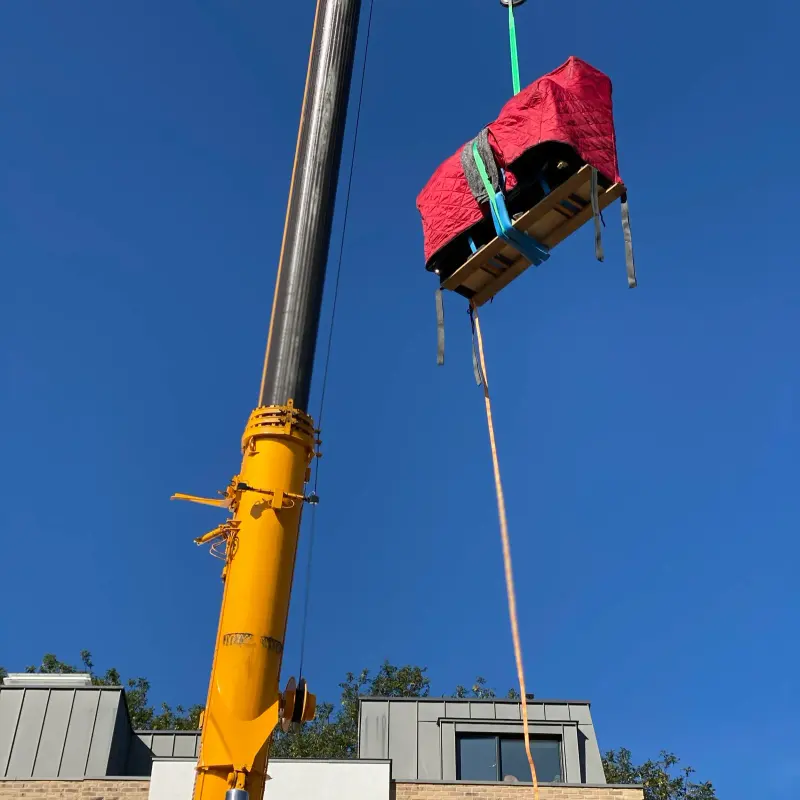
When internal stairs are too tight, there is no pavement hatch, and the garden route to the rear is blocked or absent, a crane is the solution. This is less common than the other routes but it is not unusual. The crane is positioned on the street, a sling is attached around the transit cover and the instrument is lifted in a controlled arc from the basement window opening or a specially widened access point to the crane's low-loader.
Crane lifts require a street closure or a formal road restriction, which the specialist organises through the local authority. In London, this is a permit issued under the Traffic Management Act and the lead time is typically ten working days. When you know a crane is likely, booking early gives the specialist enough time to apply for the permit and avoid delays on the day. The crane itself is sized to the instrument: a baby grand out of a Mayfair basement needs different rigging from a full upright out of a Camden conversion.
The instrument is fully wrapped before it leaves the room. The wrap stays on through the lift, through the loading and until it reaches the destination. Nothing is removed until the piano is in its final position and the crew has confirmed no marks or movement have occurred during transit.
What to tell the specialist before booking
The more information you give at the booking stage, the more accurate the fixed price and the fewer surprises on the day. The key information a specialist needs for a basement extraction is:
- The piano type and approximate dimensions: upright or grand, the make and model if known, and the height for an upright or the longest dimension for a grand
- The floor the piano is on: basement level and whether it is a full basement, a lower ground floor or a semi-basement with partial street-level access
- The internal stair details: the width of the staircase, the headroom at the foot and the top, and whether there are any tight turns between the room and the front door
- The external access: whether there is a pavement hatch or light well, the size of the opening, and whether the front or rear of the property has level access to the street
- The destination: where the piano is going, whether that is another property, a storage facility or a dealer, and the stair or lift situation at the other end
If you are not sure about the measurements, a rough estimate is still more useful than nothing. The booking team can work from approximate dimensions and flag if a site visit is needed before confirming the price.
What happens on the day
The crew arrives with a transit cover, a skid board, carrying straps, wall and floor protection, and the specific hoist or lifting equipment that was agreed at survey. The room is assessed again to confirm nothing has changed. The route out is walked through. Floor protection goes down in the hallway and on the stairs before the piano moves.
For a hoist or crane lift, the external equipment is set up and tested before the piano is moved into lifting position. The instrument does not leave the floor until everything is in place and the crew is satisfied with the rig. Speed is never the priority at this stage.
The full move from arrival to van-loaded typically takes between one and three hours depending on the route and the number of stairs involved. A crane operation with a street closure can take longer, since the crane has to be positioned and the road closed before work begins.
Frequently asked questions about basement piano removal
How much does it cost to get a piano out of a basement?
Piano moves start from £125. Basement extraction is priced on the access route, the number of stairs, whether a hoist or crane is required, and the destination. Stair access is chargeable and is included in the full fixed price calculated automatically when you book at book.pianospeed.com. For a crane operation the permit and crane hire are included in the quote.
Can any piano mover get a piano out of a basement?
No. Basement extractions using a hoist, a pavement lift or a crane require specific equipment, an understanding of load rigging, and in the case of a crane, the ability to manage a road restriction permit. A general removals firm will not have this capability. Specialist piano movers who work in central London regularly handle basement extraction as part of their normal workload.
How long does a basement piano extraction take to book?
For stair and hoist extractions, booking lead time is usually a few days to a week. For a crane operation, allow at least ten to fourteen working days to allow for the road restriction permit. If you know a crane is likely from the start, contact the specialist as early as possible.
What if my staircase is too narrow to get the piano out?
The specialist will identify this at the survey or assessment stage and recommend the alternative route, whether that is a pavement hoist or a crane extraction. It is very rare for a piano to be truly stuck: there is almost always a viable route. The assessment stage exists specifically to find it before the crew commits to a method.
Do I need to be present for the extraction?
You or a trusted representative should be present, particularly for a crane operation where road access and coordination with the building are involved. For a straightforward stair or hoist extraction the same applies: someone who can make decisions about the property and confirm the instrument's condition before it leaves.
Will the walls and floors be protected during extraction?
Yes. Floor protection, stair protection and wall padding are standard for any specialist extraction. The transit cover on the piano itself prevents contact between the case and any surface during the move. If the route requires passing close to painted walls or architraves, the crew will pad those too.
Book a basement extraction or get a fixed price
Whether the route out is a staircase, a pavement hoist or a crane, the full price including access and stair charges is calculated automatically when you book at book.pianospeed.com. For complex access that needs a conversation first, call 020 7164 0000. PianoSpeed London Limited, 71-75 Shelton Street, Covent Garden, London WC2H 9JQ, is rated 4.9 out of 5 on Trustpilot from 77 reviews. Piano moves start from £125.
Book your move in 2 minutes
When it has to arrive perfectly, there is no second choice.
Get an instant quote★★★★★ Rated 4.9 out of 5 on Trustpilot from 77 reviews