
Blog · 31 October 2026
Moving a piano into or out of a pub or restaurant: access, licensing and timing
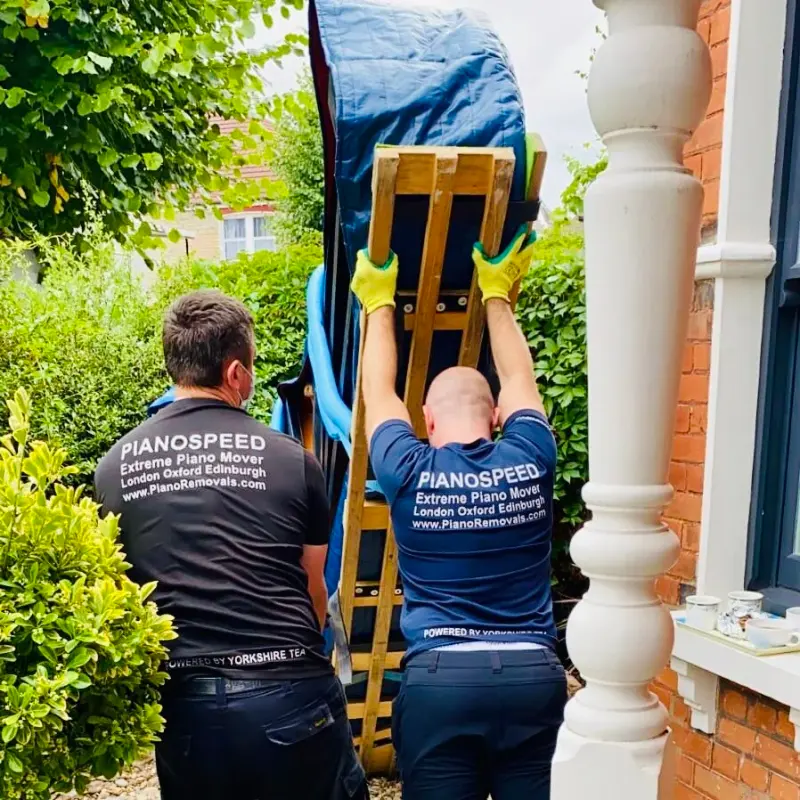
A piano move at a licensed venue takes more planning than a residential job of the same distance. The access routes, the timing constraints and the parking situation at a typical London high street or town-centre location each add a layer that needs resolving before the crew arrives. PianoSpeed handles piano moves for pubs, restaurants, gastropubs, private members' clubs and hotel dining rooms across London, Greater London, Surrey, the GB mainland and Belfast and Northern Ireland. Piano moves start from £125 and the fixed price for your specific venue is at book.pianospeed.com.
Access routes at pubs and restaurants
Many Victorian and Edwardian pubs were built with a step down from the street, either a single threshold step or a half-flight into a basement bar. A piano on a skid board cannot negotiate an unplanned step, and the crew needs to know about it before arriving. The right preparation turns this into a straightforward ramp approach. Photographs of the entrance and any internal steps, sent with the booking, are the most useful thing a venue manager can provide.
The bar area adds a second constraint. Fixed bar counters with gantry fittings, bar stools and high seating limit the turning room between the entrance and the final position. The crew needs to know where the piano is going and whether it can reach that position without passing behind the bar or through a kitchen that is narrower than the instrument.
Restaurants have their own equivalent. Fixed booth seating, close-set tables and banquette runs along walls mean the crew works around furniture that cannot always be shifted. Clearing the direct route before the crew arrives reduces the risk of marks on floors, walls and fittings. Anything the venue can move ahead of time shortens the job and protects the venue.
Timing around opening hours and service periods
A licensed premises cannot absorb a piano move during service. Customers, staff, an active kitchen and the need to keep the venue clean all point to scheduling outside trading hours. For a London pub that opens at midday and closes at midnight, the practical window is 8am to 11am. For a restaurant with a lunch service from noon, the kitchen is often in prep from 9am and the venue needs to be clear before that.
A Friday or Saturday late-night close pushes the earliest practical Saturday or Sunday access to 9am or 10am depending on staff availability. Many venues find the simplest solution is to schedule the move on their weekly closing day: Monday for many restaurants, Sunday afternoon for pubs with an early Sunday close.
When booking, confirm the day, the start time and the name of the person who will provide access on the day. The booking team can hold a specific time slot once the details are agreed. A last-minute call from a manager who has forgotten the booking is one of the most common reasons a pub or restaurant piano move is delayed on the day.
Parking and loading on busy venue streets
Pubs and restaurants are typically on commercial high streets, town squares and former market streets where parking is restricted. In London, many of these are Red Routes where stopping to unload is not permitted at any time. A piano move on a Red Route needs a parking suspension from the relevant London borough, and that suspension takes several working days to arrange from when the application is submitted.
Outside London, yellow-line restrictions on busy commercial streets can prevent the vehicle pulling close to the entrance. A bus stop or loading-bay markings reserved for a specific business may block the direct approach, and the crew may need to carry the instrument further than the shortest possible distance.
When booking, the team asks about parking. If the venue is on a restricted street, raise this at the booking stage so a suspension can be applied for or an alternative loading point agreed. A crew arriving to find no viable parking position close to the entrance creates a delay that is entirely avoidable with a brief conversation at the time of booking.
Stairs and multi-level venues
Function rooms above a pub, a private dining room on an upper floor and restaurant mezzanines are all common destinations for a piano that will serve as a performance instrument. Stairs are chargeable. The charge reflects the additional crew time and the physical demands of a heavy instrument over a staircase that may be narrower and steeper than a domestic stair.
Victorian pub staircases are often particularly tight. The width of the flight, the height between treads and the presence or absence of a half-landing all determine how the crew approaches the job. A staircase with a turn at the top or a landing too short to set the instrument down for a change of grip requires more crew members and more time. The stair charge is included in the fixed price at book.pianospeed.com once you describe the floor level at each end.
Cellar access is a related consideration. Some venues want a piano positioned over or near a cellar hatch. The crew needs to know the floor plan so the skid board does not rest on a hatch that is not rated for the load. Flag the hatch position when booking.
Protecting the venue during the move
The floors, walls and fittings of a pub or restaurant are a trading asset. Marks on a bar counter, a gouge in a wooden floor or a cracked tile in a kitchen corridor each translate into repair costs and potential closure time. The crew uses protective floor runners, corner and edge protectors and transit covers from the moment the instrument enters the building.
In practice, the most vulnerable surfaces are the floor from the entrance to the final position, the door frames along the route and any furniture the piano passes close to. If the venue has a particularly sensitive floor, such as original encaustic tiles, Victorian hexagonal mosaic or a resin-poured surface, note this when booking so the crew can bring appropriate additional covering.
Which type of piano works in a pub or restaurant
The traditional pub piano is an upright. An upright takes up less floor space than a baby grand, it sits against a wall and it is easier to manoeuvre through a narrow bar than a larger instrument. Uprights appear in traditional London pubs, in gastropub dining rooms and in private function rooms above bars across the UK and in Northern Ireland.
Baby grands have become more common in upscale restaurants and hotel dining rooms where the piano is as much a design statement as an entertainment instrument. A baby grand in the corner of a dining room suits the acoustics of a reflective room and signals a level of formality that an upright does not. The access demands are higher: legs and the pedal lyre are removed before the body travels on a skid board in a heavy-duty crate, with a larger crew. The booking process is the same.
Concert grands occasionally appear in hotel ballrooms that double as restaurant spaces and in private members' clubs with a dedicated music room. Where a concert grand is needed, a site visit to confirm the route happens before the date is set.
Questions pubs and restaurants ask most often
Do we need to tell our insurer about a piano move?
It is worth checking. Commercial property and pub or restaurant-specific policies vary in their requirements around large deliveries and what they treat as a notifiable event. Confirming with your insurer before booking is a short task and avoids any question about cover at the time of the move.
Can a piano be moved in outside trading hours?
Yes. For venues that prefer a late-night or early-morning slot, the team can discuss timing when you book. After closing time on a quieter weekday is often practical: the street is less busy, parking restrictions are often less severe and the venue staff are on site for the close.
Is there a way to avoid bringing the piano through the front of house?
Sometimes yes. An external access route through a pub yard, a beer garden or a fire-exit corridor can bypass the front entrance entirely. If the venue has rear or side access, note this when booking and the team will assess whether it is the better route. External access at ground level also avoids any step at the front door.
How long does a pub or restaurant piano move take?
For a standard upright delivered to ground level with clear access, the crew is typically in and out within 45 minutes to an hour of gaining access. A baby grand, a carry up to a function room or a venue with restricted corridors will take longer. The booking team gives an indicative time window when you confirm the details.
Do you move digital pianos and keyboards to venues?
Yes. Digital pianos and stage keyboards are handled with appropriate packing and transit protection for electronics. Many venues use a Roland, Yamaha Clavinova or Kawai digital instrument for performances and need it moved between buildings or into a new location within the same venue. The booking form at book.pianospeed.com covers digital instruments.
Book a specialist crew for your venue move
For an instant fixed price covering the access at your pub or restaurant, get a quote at book.pianospeed.com or call 020 7164 0000. Piano moves start from £125. PianoSpeed London Limited, 71-75 Shelton Street, Covent Garden, London WC2H 9JQ. Rated 4.9 out of 5 on Trustpilot from 77 reviews.
Book your move in 2 minutes
When it has to arrive perfectly, there is no second choice.
Get an instant quote★★★★★ Rated 4.9 out of 5 on Trustpilot from 77 reviews